
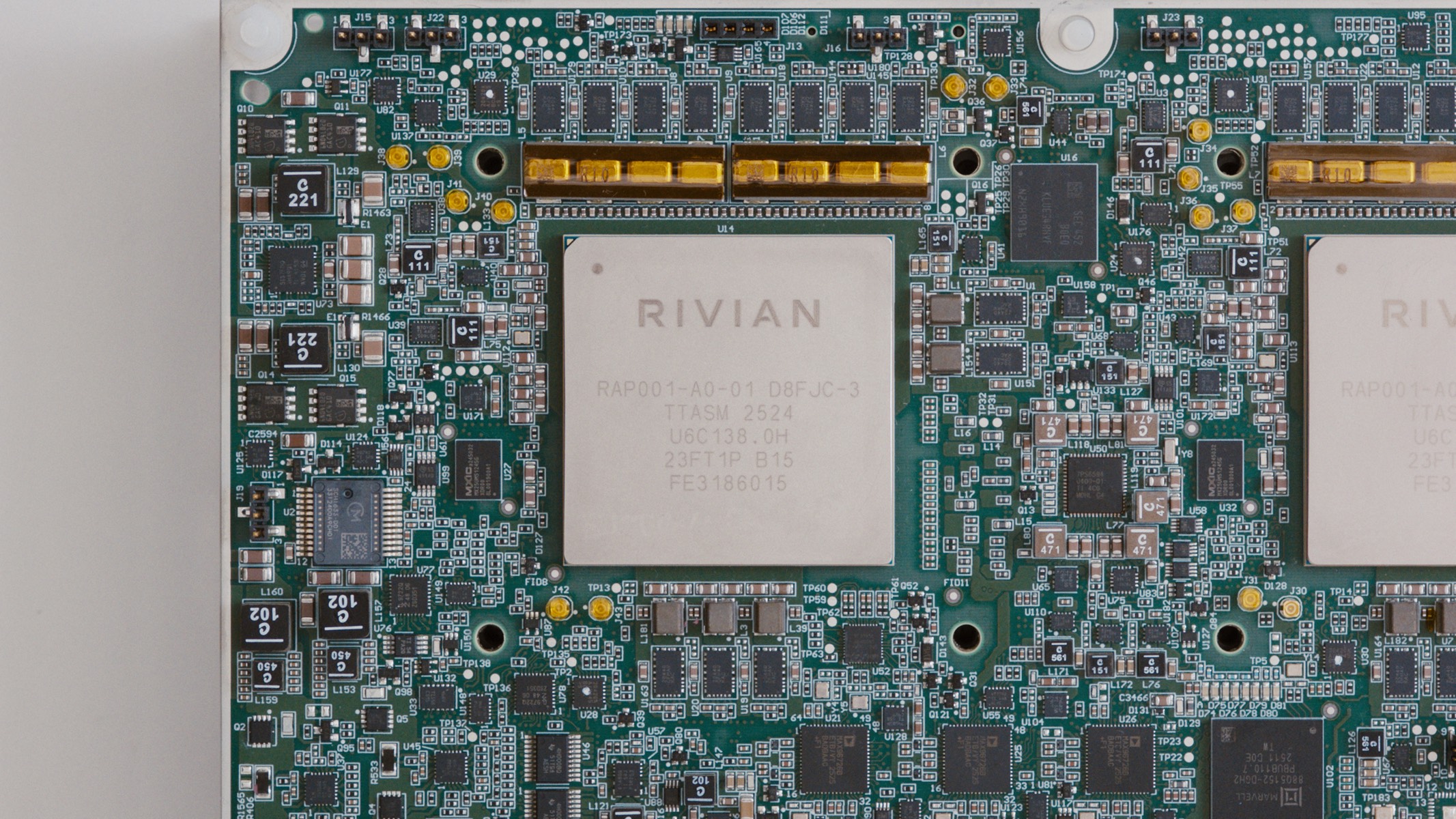
Gen 3 autonomy hardware will come in two performance levels, and the lower one costs less than the Gen 2 hardware Rivian ships today. That was the one new number out of the Goldman Sachs Communacopia conference yesterday, where James Philbin, Vidya Rajagopalan and Chip Newcom otherwise held every date already on the record: the second shift at Normal in Q3, point to point autonomy late this year, and automotive gross profit positive on a Q4 exit rate.
Shoutout to Rivian_DD on X for putting together a great summary.
R2 production and the Q4 target
Newcom said Rivian is “still planning to add a second shift here in the third quarter.” No new bottlenecks were named. Q3 ends September 30, and COO Javier Varela said on the Q2 call that the added volume does not show up until Q4.
Order conversion continues to trend well, and each color and interior release is bringing in additional demand: “as we introduce each of those new waves, more interest coming through from customers.” Rivian has still not attached a number to conversion.
The profitability language was unchanged from February. Rivian is “on our way towards achieving automotive gross profit positive on an exit rate basis,” meaning the rate the company is running at as Q4 ends rather than the full quarter’s result. Asked whether unusual pricing or cost reduction assumptions sit behind the target, the answer was no: “It’s all about scaling and building more R2s.” Rivian has not given a specific volume number for what it takes to get there.
Autonomy
Point to point remains on track for late this year. Uber’s CEO and CFO both received demos recently.
Asked about the biggest remaining technical challenges, Philbin pointed to overcaution: “making sure the model is not too conservative, that it’s sort of tracking speed as you would expect.” Harder scenarios are reportedly in better shape, with “very good behavior around relatively complex scenarios like construction or narrow negotiation.”
Customer driving data alone will not produce the target behavior, since drivers roll stop signs and speed. Rivian blends in expert driver data at roughly one part in ten to correct for that.
Gen 3 hardware and RAP1
The two Gen 3 autonomy hardware performance levels price out differently. The lower one costs less than the Gen 2 hardware Rivian ships today, and the higher one costs about the same or slightly more.
What Rivian did not say is how those levels map to trims. My read is that the cheaper version lands on the R2 Standard while Performance and Premium get the higher one, which would match how Rivian has staged the rest of the R2 option sheet, though that is an assumption and not something the company has stated.
The autonomy software already runs on the RAP1 chip and is meeting performance targets without fully optimized software. Hardware characterization testing is ongoing and should be largely complete in about six weeks.
On compute supply, Philbin said GPU capacity through AWS is secured for at least the next six to nine months. “Past that, of course, we’ll need to see.”
Rajagopalan also said Rivian is open to selling the chip outside of vehicles, inviting anyone interested in using it for robots to reach out.
The next checkpoint is September 30, when the second shift is due at Normal.



Can you clarify on the 2 performance levels? Is that with and without lidar for the base model?
My read is that the cheaper version lands on the R2 Standard while Performance and Premium get the higher one. But there was no much clarity beyond what I shared.
Theres no standard without LiDAR
This is the first I’ve heard of two different Gen3 Autonomy hardware levels? Do you have any additional information regarding what this means for performance/capabilities? Assume this in some way will align with Lidar???
My read is that the cheaper version lands on the R2 Standard while Performance and Premium get the higher one. But there was no much clarity beyond what I shared.
When will R1 get Gen 3?
Most likely model year 2028
Having two discrete performance levels for the Gen3 hardware is puzzling. Since software functionality costs the same regardless of pricing, the only reason to offer a “crippled” feature set in software is just product differentiation, adding nothing to the bottom line. And from a hardware standpoint, the RAP1 chipset manufacturing cost is the same even if you lower the clock speed or disable some on-chip features. Stripping a little memory out could save some cost, but that would cripple the functionality of Autonomy+ — not an area where you want to limit your product experience or safety. Cutting out the LiDAR would certainly lower costs, but it would diminish Rivian’s ability to gather “ground truth” data for their Point-to-Point data flywheel. A little self-defeating. A real puzzler.
Consider the possibility that the lower end RAP1 goes in all R2s and the high-end one goes in the next gen R1.
I’m guessing that premium and performance level trim swill get lidar and standard will not get it. Helps protect their margins, while giving some further inventive to upgrade to the higher trim – especially since I suspect any eyes off highway will be restricted to vehicles with lidar only.
In theory they could also cut the compute in half for the standard. Without lidar, I don’t think the extra compute is needed. For the first year, that extra compute will only be used for ground truth data gathering – it won’t be used for the model at all. And if Gen 2 can run the point to point they’re working on, then a Gen 3 cut in half should also be able to run it.
Lastly, the standard trim is not going to be a volume seller the way the premium and performance will be. So not having lidar there isn’t going to effect the data gathering much from a numbers perspective.
All of this seems like very reasonable tradeoffs, given what they’re saying about costs / margins
Gen3 does use a dual RAP1 configuration, so depending on the packaging, I suppose it is possible to cut costs by removing one set of chips. When I worked for Sequent Computers 40 years ago minicomputers started at $50,000 and ranged up to a $1,000,000. We packaged our cpus in pairs on a single board. Every once in a while, a new marketing type would suggest a lower priced single cpu configuration. We then had to explain to the newbie that the cost of a single cpu board was basically the same as the dual cpu board and would increase our inventory and service costs. If we simply ‘turned off’ the second cpu to save manufacturing a custom board, we’d only cut our margins, not our costs. Only if the RAP1 chip set is discretely packaged then it might make manufacturing a low end product for the Standard R2 feasible without hurting margins. The whole point of switching from Nvidia (with their 75% net margins) to direct from TSMC at much lower cost is to recapture some of that margin. I guess we’ll just have to wait and see after they make the actual price and configuration announcement in a few months.
I agree but even if they break even it might make sense from a supply standpoint. Right now both chips and memory and in high demand / short supply. It may make sense to hold as much supply as possible for the volume trim with higher overall margins.
Also I’m assuming this scales down because of the Rivian link because they have previously said it can scale up easily. But that is purely an assumption and it may not be correct
When in doubt, ask Rivian Assistant 🙂
Rivian has stated that Gen 3 will have two performance levels, implying a reduced configuration (say, splitting the dual-chip configuration), or adding more compute power beyond the standard dual-chip
Agent said
You’re right—Rivian has shared that the Gen 3 Autonomy Computer (powered by RAP1 chips) will offer two performance levels. The standard consumer setup uses two RAP1 chips, delivering 1600 TOPS of AI compute. There’s no mention in official resources of a configuration with just one or three RAP1 units, nor of a higher-than-dual-chip setup for consumer vehicles at this time.
The two performance levels likely refer to software-enabled differences or possibly a reduced hardware configuration, but so far, only the dual-chip setup is confirmed for production vehicles.
As of 6/30/26, Rivian has raised about $38 bill. Between 260 mile range and $60k starting price, the R2 has no chance. Combined with Rivian’s quarterly billion dollar losses and inability to project a net profit, how is Rivian not headed for Ch 11?
Rivian is about 5 years into selling actual cars. Tesla took 12 years before they turned into EBITDA positive. And Tesla had much more generous subsidies to pad their books.
Consensus estimates put them ahead of Tesla on that timeline, reaching positive ebitda per share by close of fiscal 28. That would be 7 years into selling vehicles, 5 years faster then Tesla did it
Rivian is doing just fine.
One for owner, one for robotaxi?
Jose, what’s your read on when the Gen 3 hardware will be released? RJ seems to be bullish that it will arrive at the end of this year, though I keep hearing sometime next year. Are we talking about 3 months from now, or are we talking about 6 to 8 months from now?
Rivian keeps saying public (and in private) end of year so that’s really I can go by. I have no secret information to share on it haha
Great forum. What hasn’t been discussed is the group of buyers stuck in limbo about when to build. I’m an Aug 2024 reservation about to build an R2 with Gen 2 or trying to decide if I can punt a few (or a lot) months in order to get Gen 3 hardware. Understanding if all the launch vehicles will be Gen 2 before switching over but then you lose the launch incentives (tow package, autonomy +, colors) for launch. I’m happy to punt but don’t know how long I’ll have to wait.