

When Rivian announced RAP1 and the Gen 3 Autonomy Computer at its first ever Autonomy and AI Day, what we were really watching was Rivian’s Apple Silicon moment. This is the company moving off generic, off the shelf compute and stepping fully into custom hardware that was designed from the ground up to do exactly one thing extremely well. The parallel to what Apple did when it dropped Intel and built its own M-series chips is hard to ignore once you start looking at the stack.
Apple’s move to its own silicon was never really about benchmarks. It was about owning the whole pipeline so the software, the chip, and the user experience could be co-designed. That control unlocked things that Intel-based Macs could never have done. All day battery life, fanless laptops still running heavy workloads, and a unified architecture across iPhone, iPad, and Mac. That whole story is what Rivian is now starting to write for itself.
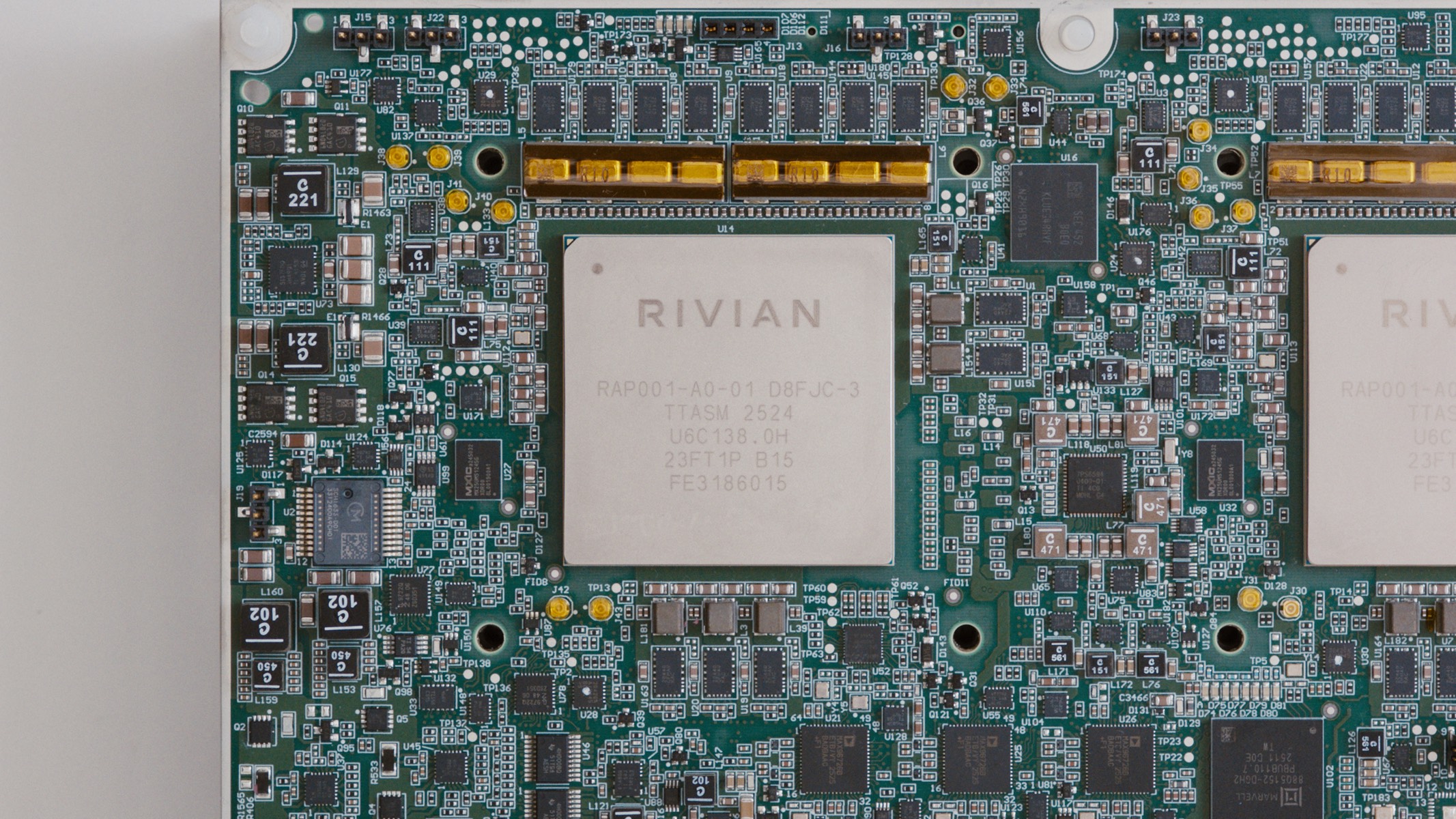
RAP1 is the foundation. It’s a custom 5nm processor built in collaboration with Arm on the Armv9 architecture, and it powers the Autonomy Compute Module 3, also known as ACM3. The numbers are wild. We’re talking 1600 sparse INT8 TOPS and 5 billion pixels per second of processing throughput. For context, two RAP1 chips together deliver more raw AI compute than an Nvidia RTX 4090. That’s the brain going into the R2 starting late 2026.
But the real story isn’t the spec sheet.
The real story is the vertical integration. Rivian didn’t just design a chip. They built their own AI compiler, their own platform software, and a proprietary low latency interconnect called RivLink that lets multiple chips link together for even more compute as future generations need it. They own the whole stack now, from the silicon all the way up to the Large Driving Model running on top of it.
That’s the Apple moment.
Just like Apple got tired of waiting on Intel’s roadmap, Rivian got tired of being stuck on someone else’s autonomy compute timeline. The original Mobileye based stack on Gen 1 R1 vehicles became a textbook example of what happens when you don’t control your own destiny. The platform got stuck. Features couldn’t evolve the way they needed to. The radar wasn’t there. Even with capable cameras, the underlying compute couldn’t be pushed because Rivian wasn’t the one designing it. Gen 2 was a real step forward with Rivian writing its own software, but it was still running on hardware that someone else set the rules for. RAP1 is the moment Rivian stops renting and starts owning.
What makes this even more interesting is the abstraction layer Rivian built underneath it all. Engineers at Autonomy and AI Day talked about a middleware layer that lets the same autonomy code run on Gen 2 and Gen 3 hardware with little to no modification. That’s a huge deal. It means Rivian can keep developing its software stack against one unified target while shipping different physical hardware to different vehicles. Apple did the same thing with Rosetta during the Intel to Apple Silicon transition, keeping the software ecosystem intact while the hardware story changed underneath.
The thing nobody is really saying out loud is that this also opens a door way beyond cars. Arm itself flagged the bigger opportunity in its own press release, calling Rivian an AI-native automaker and pointing toward the broader physical AI economy in robotics, logistics, and industrial automation. RAP1 wasn’t designed to be a one trick chip. RivLink as a scalable interconnect is the kind of thing you build when you’re thinking five and ten years out, not just R2.
For owners, the practical impact is going to be uneven for a while. R2 launches on Gen 2 hardware, then transitions to Gen 3 with RAP1 and LiDAR later in 2026. There’s no upgrade path between the two, and Gen 1 R1 owners are largely sitting outside this conversation entirely because that platform was never going to scale into eyes-off autonomy. That’s a real cost of vertical integration. Apple owners felt the same growing pain when entire generations of Intel Macs effectively got frozen in time the moment M1 arrived.
But that’s also why this matters so much for Rivian as a company. Once you own the chip, you’re not competing on who did the better job integrating someone else’s parts. You’re competing on architecture and software, and that’s a much more defensible place to be. It also opens the kind of licensing and platform play that the VW joint venture has been hinting at, where Rivian eventually sells a tuned hardware and software stack to other automakers who can’t afford to do this themselves.
We’re early. Validation isn’t done. The first Gen 3 vehicles are still months away. The Large Driving Model is still being trained on fleet data from current Rivians acting as rolling sensors. But the pieces being put down right now feel structurally similar to where Apple was around 2018 and 2019. Quietly transitioning. Designing in house. Setting up something that will only look obvious in hindsight.
If RAP1 lives up to half of what Rivian showed at Autonomy and AI Day, the next few years of this company are going to look very different from the last few.



Small stockholder here (cost basis $21/share, +/-) Can you explain to me in layman’s terms how Rivian can monetize this beyond their own EVs? Would this chip architecture and/or related software be licensed to other automakers or others in the transportation space? Would there be subscription income from this? So many questions…
Great question and honestly the part that gets me most excited about RAP1 too.
In layman’s terms, there are basically three ways Rivian could monetize this beyond their own vehicles.
First, licensing to other automakers. The VW joint venture is already the proof of concept. Reuters reported earlier in 2025 that other automakers were “knocking on the door” about the tech coming out of that JV. With RAP1 and the Gen 3 stack now public, Rivian has something even more concrete to sell. Think of it as a tuned hardware and software bundle that another OEM could drop into their own vehicle and skip years of integration pain. The electrical architecture, the compute module, the autonomy compiler, even the validation tooling. All of it can be sold as a package or in pieces.
Second, subscription revenue on their own fleet. Autonomy+ at $49.99 a month or $2,500 one time is already live. As features get more capable (eyes off, point to point, eventually personal Level 4) the value of that subscription grows. More owners signing up, fewer cancelling, and probably higher pricing tiers down the road as capability expands.
Third, the part nobody talks about much, physical AI beyond cars. Arm specifically called out the broader physical AI economy in its press release with Rivian. Robotics, logistics, industrial automation. RAP1 with RivLink is designed to scale by linking chips together, which is exactly the architecture you’d want if you were eyeing markets outside automotive. Whether Rivian actually goes there is a different question, but the chip wasn’t designed to be a one trick pony.
Now the honest caveat. None of this is guaranteed and the timeline matters a lot. Licensing deals take years to materialize, Autonomy+ revenue is still early, and any non-automotive play is speculative. But the strategic optionality is real, and that’s what I think the market hasn’t fully priced in yet.
Not financial advice, just one owner’s read on what they’re building.
RAP3 will be a very controversial release 😂
Thanks for the clarification—much appreciated!
This is why I’m not a shareholder anymore, this is a pure vanity project trying to copy Tesla. Yet they didn’t understand why Tesla moved to AI. Tesla has the money for vanity moonshot projects, Rivian does not
Will the Rap1 chip be available in the launch edition models?
Rivian hasn’t specifically said if it will or won’t
Vis a vis hands off eyes off autonomy, here’s what people are missing — Amazon vans by the tens of thousands. They’ll need to buy new ones to get RAP1, they’ll ground proof most of earth’s roads by the Petabytes, they’ll help Rivian drivers with all that data and financial support. This company goes to the moon if they can survive for 18 more months.