
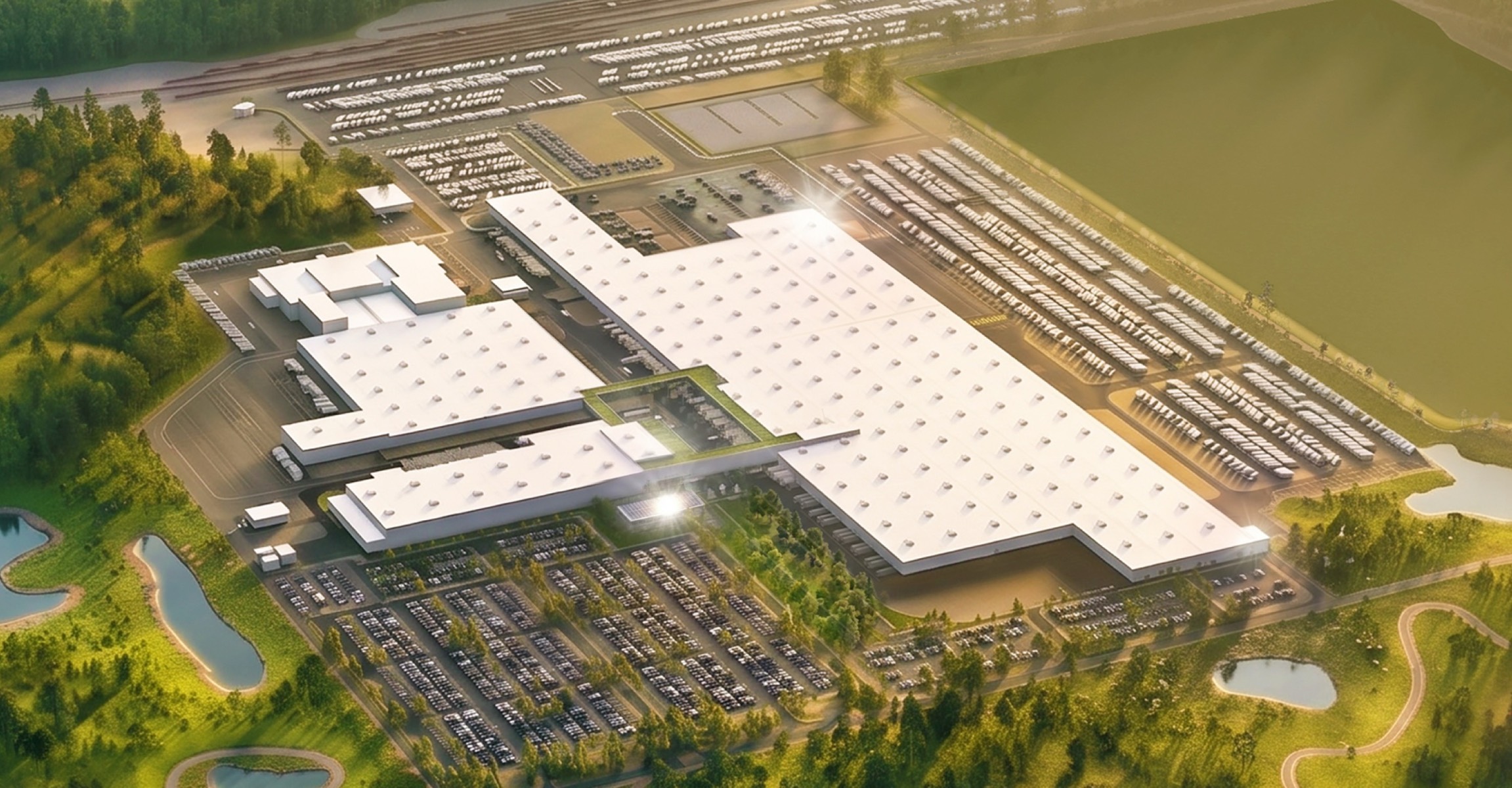
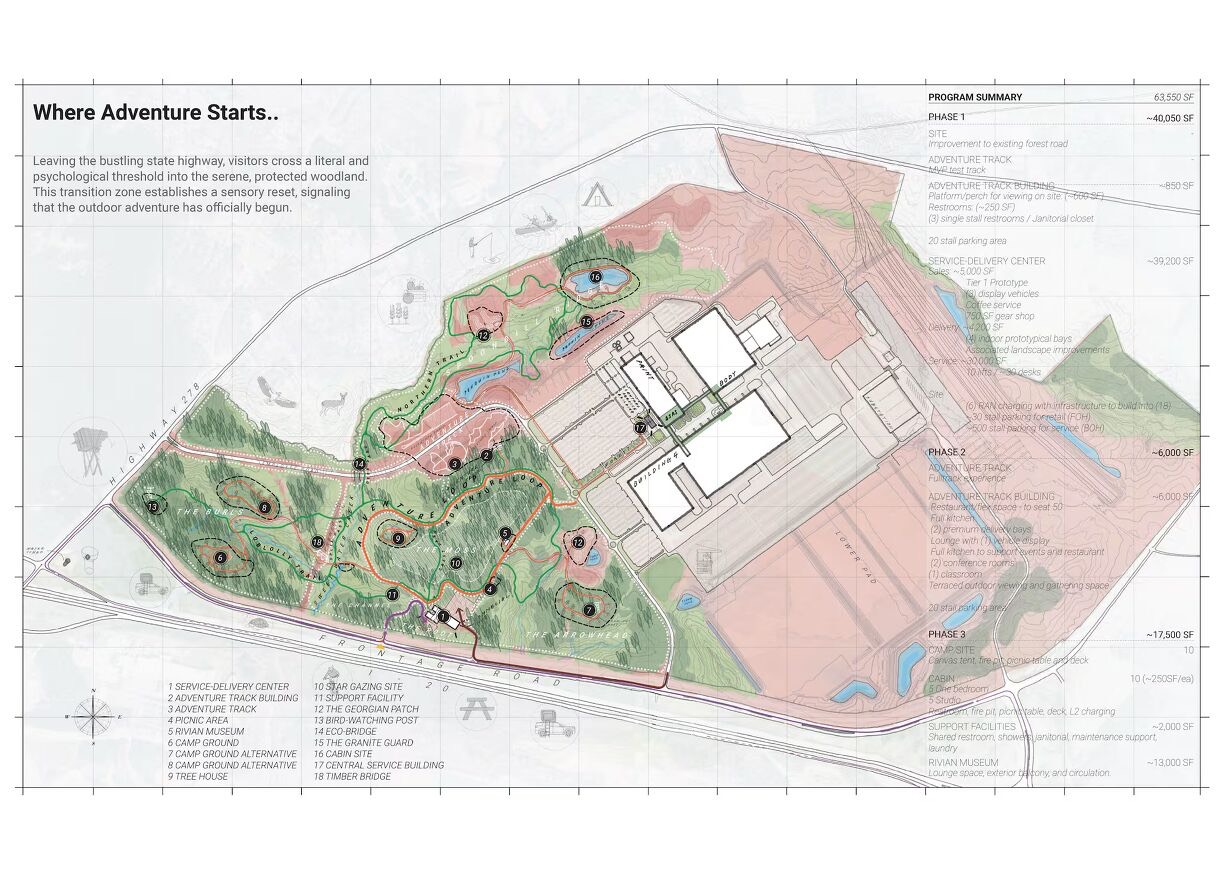
For its $5 billion plant in Stanton Springs North, Georgia, Rivian has published site plans and renderings, the layout of which goes beyond that of an assembly facility. During a press briefing at its newly opened East Coast headquarters in Atlanta, the company went through the plans and demonstrated an industrial area surrounded by land intended for public use which in the end will contain a museum, walking trails, campsites, eco-cabins and an off-road test track.
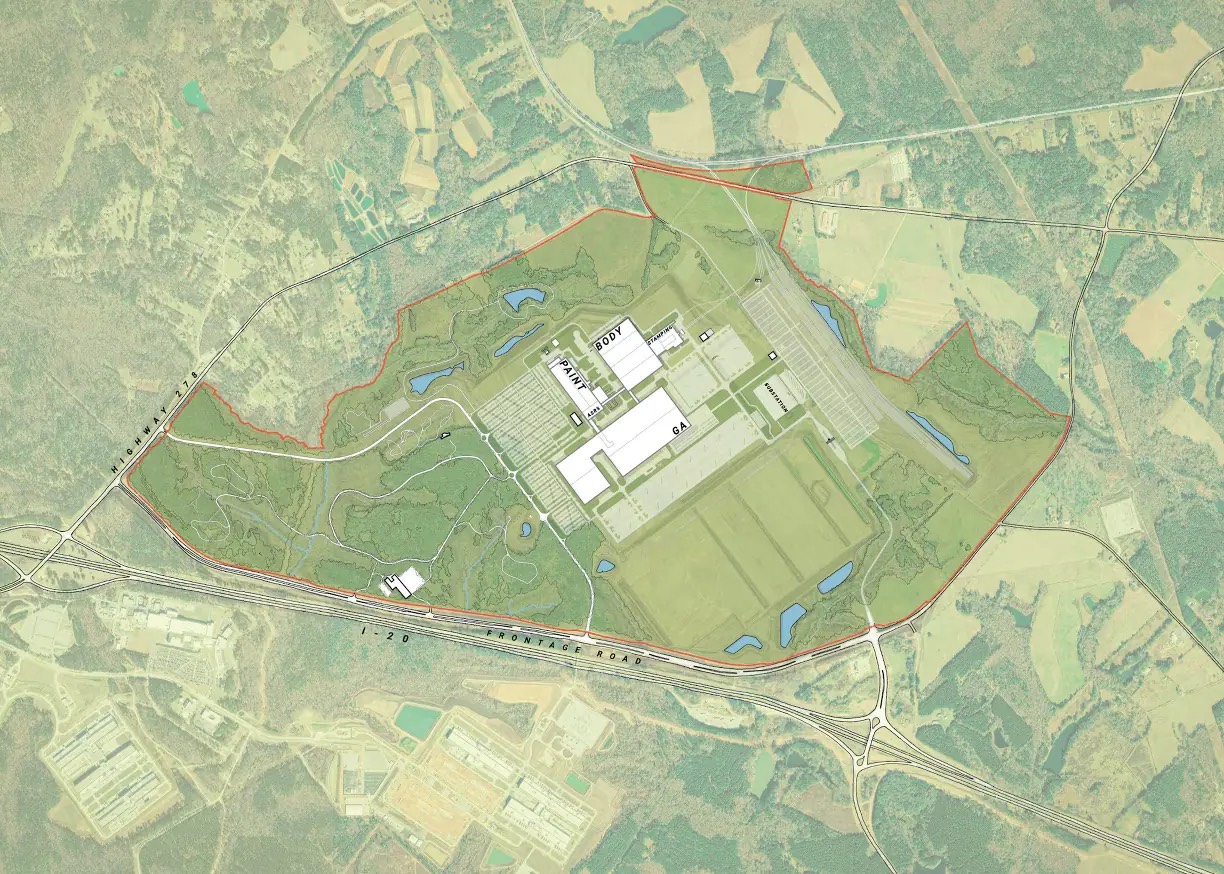
The property extends for about 2,000 acres along Interstate 20 and Highway 278, lying approximately 45 miles east of Atlanta in the southern parts of Walton and Morgan counties. When satellite images are overlaid on the site map, they reveal the main buildings in a sequential arrangement, with the stamping plant being situated directly adjacent to the body shop, which in turn feeds into the paint and general assembly operations. There is also an automated storage and retrieval facility located in the vicinity, and a rail marshaling yard situated along the eastern boundary links to the CSX main line so that finished vehicles can be transported to Atlanta and the Georgia ports. Furthermore, a new interchange on I-20 near Social Circle is also intended to bring truck traffic quickly onto the property, rather than having it use the local roads.
Work is already underway on the foundations of two large stamping presses, something that Rivian has referred to as the most complex building on the campus. Utility and road work are also being carried out. At this point, the schedule changes, with Tony Sanger, Vice President of Production Facilities, stating that the main buildings will be constructed at the same time rather than one following the other, and he told reporters that “all those buildings are going to come out of the ground at the same time”. The plan provides for the entire site to be enclosed in 2027, thus allowing the tooling to be installed and commissioned before customer vehicle production begins in 2028.
The initial capacity is 300,000 vehicles per year and this space is meant for producing the R2, the R3, the R3X, and the autonomous vehicles associated with the Uber partnership that was announced earlier this year. Rivian has already mentioned that the site will reach a capacity of 400,000 vehicles per year when the second phase is completed, so the figure of 300,000 represents the starting capacity and not the maximum.
The section of the campus that is facing the customers amounts to approximately 63,550 square feet and is being provided in three stages. The first of these stages consists of a 39,200-square-foot service and delivery centre featuring 10 service lifts, four indoor delivery bays, a retail shop, six charging stalls, and an initial test track together with a viewing pavilion. The second stage extends the track to provide a complete driving experience, centred around a 6,000-square-foot building that includes a 50-seat restaurant, a vehicle display lounge, a classroom, and terraced outdoor seating for spectators. The third stage is the part that will attract the most interest from the owners, as it contains 10 canvas-tent campsites with fire pits, 10 eco-cabins of 250 square feet each with Level 2 charging, and a Rivian museum covering 13,000 square feet.
About half of the property, amounting to roughly 1,000 acres, remains as preserved woodland. In the western part there are named trails such as The Burls, The Moss, The Arrowhead, and the Loblolly Trail, and the public grounds are intended to have a treehouse, bird-watching posts, a stargazing area, and timber eco-bridges spanning the retention ponds. The service center is designed as a two-story glass pavilion situated under a substantial timber canopy, and it is incorporated into the native meadow landscaping, matching the mass-timber style that Rivian has employed in its office spaces.
The amount of money involved in all this hasn’t changed very much: there is a state and local incentive package worth about $1.5 billion, together with a $4.5 billion loan from the Department of Energy, and Rivian plans to make its first withdrawal from that loan by early 2027. The company has raised over $1.3 billion through a public stock offering in July, and part of that money is used to meet the equity commitments linked to the DOE loan. The promise regarding jobs remains that of 7,500 permanent positions by 2030.
For anybody who has been following the project since it was announced in December 2021, the recreational build-out is the simple highlight, but the more useful information is the construction sequence. Georgia was put on hold in March 2024, resumed following the groundbreaking last September, and has since then been mostly engaged in the type of work that doesn’t photograph well. The first milestone that will be visible from the highway—that is, the phase in which the buildings go vertical in 2027—is also the point at which the 2028 production date starts to appear either feasible or tight. It is a pleasant notion to camp at a car factory and one that fits with the company’s image, though the majority of that phase comes well after the first R2 leaves the Georgia line.
Source: AutoGuide



Thanks, Jose. Your source(s) made no mention of a supplier park like they built in Normal?