
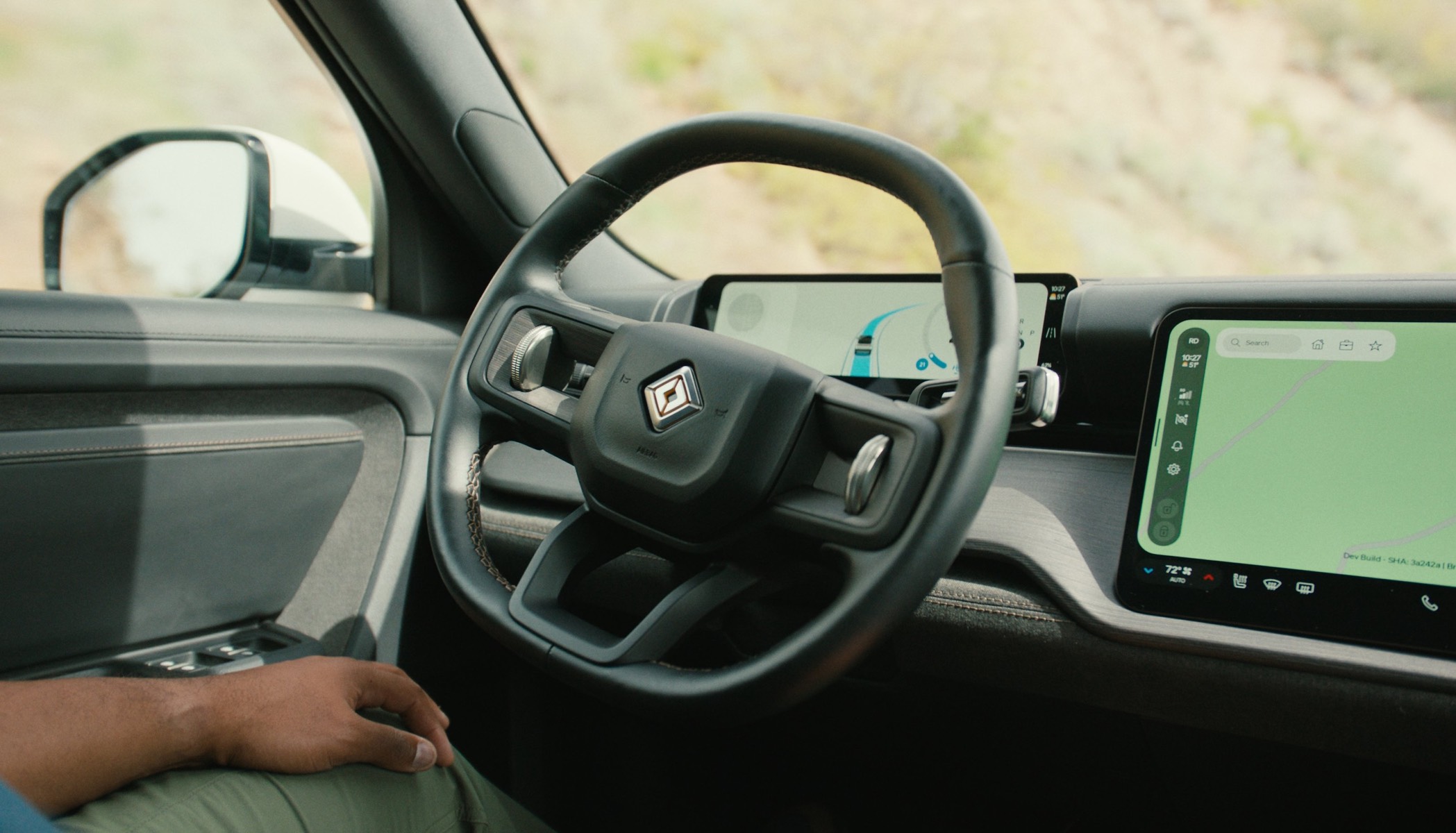
Point to Point starts reaching a small group of Gen 2 R1 and R2 owners in California and Florida in December, and it’s the first time Rivian will offer the kind of address-to-address driving Tesla owners have been using with FSD Supervised for years.
Right now Universal Hands-Free shows traffic lights and stop signs on screen but doesn’t stop for them, so you’re back in control the moment a drive leaves the highway. Point to Point is meant to close that gap. You enter an address and supervise while the vehicle works through city streets, intersections and highway interchanges on its own.
The rollout follows Tesla’s old FSD Beta playbook pretty closely too. Owners need a paid Autonomy+ subscription and have to sign an NDA, and Rivian picks them partly on safety metrics it rechecks every 30 days. Everyone else on Autonomy+ gets it sometime in 2027.
Price is where Rivian has the edge. Autonomy+ runs $49.99 a month or $2,500 one time, while FSD Supervised is $99 a month and Tesla dropped its one-time purchase back in February. If Point to Point lands anywhere near FSD, Rivian owners are getting a lot more for their money, but I fully expect Rivian to raise the price once it does, so that $2,500 option may not stay at $2,500 for long.
Tesla still has years of fleet data behind it, and James Philbin already said the first version will skip some situations like parking lots. Rivian’s argument is that the distance from UHF to Point to Point is “shorter than it looks from the outside,” with its Large Driving Model learning from every fleet mile.
Autonomy & AI Day on December 9 in Palo Alto should give us the first full look, and I’ll share more with you all as soon as Rivian shows how close it’s gotten.



As a preorder holder from back in the day, the Autonomy driving experience was never the focus. It was a busted promise for sure in Gen 1. This was positioned as lifestyle truck with power, utility and fun. I do enjoy the limited self-drive on my Gen 1 on boring stretches of highway, but would much more appreciate if Rivian focused more on charging speed, thermal management, and charging curve for the next gens. I guess the conversation shifted last year from lifestyle to an AI/self drive narrative at their first Autonomy Day. However, the comparison with Telsa shouldnt be on the FSD vs Rivian. Rivian R1s and R2 will never get the efficiency of an Model 3 or Y. Weight and aero dictate that. But they can close the gap on charging performance and efficiency (power usage while driving) without sacrificing comfort or driving experience (AC, etc). Range anxiety and charging stress are what people still talk about not wanting to deal with EVs. Yeah the FSD is cool and all but that isnt the barrier to new customers or going more mass market. That is a news headline but news headlines dont always translate into sales. People want to not think about the energy requirements 24 hours in advance or have to stop for 30 minutes+ to DC fast charge on a long driving day. I think Rivian has lost some of its way. AI has driven the stock market, so lets hop on the bandwagon. Too many articles keep pushing that narrative. But is it their best goal to max economic returns on capital? I dont think so. I love the tech and the software but if I had to pick I would prefer at least a 400v architecture with class leading thermal management that can take me 20-80% in 15 minutes or less. When you read reviews on EVs the conclusions are often comfort, livability, quality, and value. Rarely, if ever have you seen a comparison shootout win on FSD or the like. Its all the other stuff, and the engineering is what we hear less and less about. More content on AI and Autonomy which is cool, vs the engineering and quality which is what will make Rivian successful. The focus is on the new shiny thing vs what the vehicles are first, transportation and utility.