
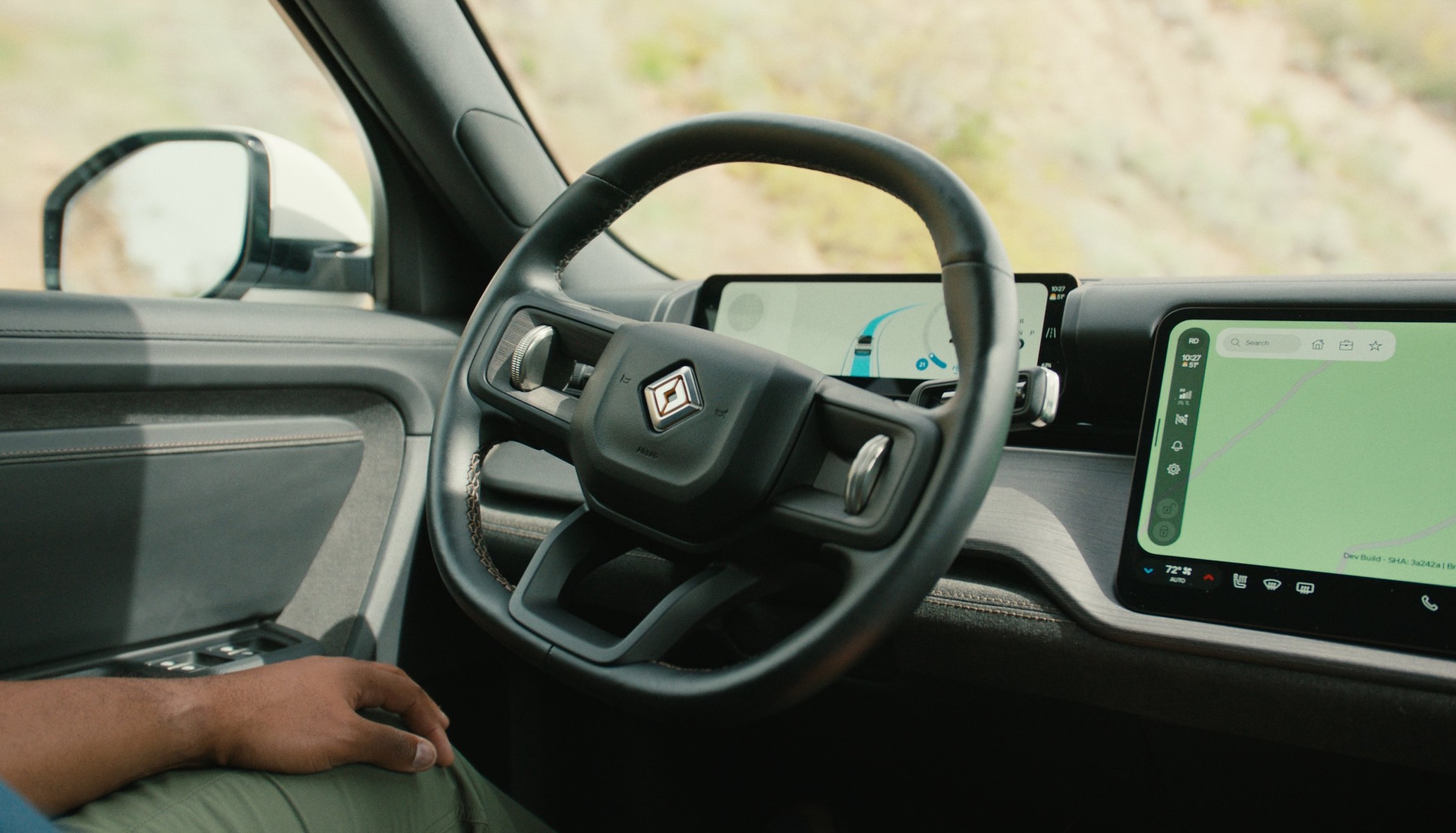
On Thursday, Rivian published a post outlining its Autonomy+ roadmap, and most of it merely repeats features that Gen 2 R1 and R2 owners already have, but a section near the bottom contains the real news. Point-to-point assisted driving will begin a limited rollout later this year, with Rivian aiming for a broad rollout to customers in 2027.
You input an address, your Rivian then travels along the route, and you keep an eye on it the entire time, covering all the streets in the city, the highway junctions, and every part in between. In the footnote Rivian makes clear the driver’s role by mentioning specific turns, lane changes, and maneuvers at intersections as examples of things that have to be continuously supervised. It stays an eyes on system.
The reason Rivian gives for believing that 2027 is achievable is that the distance between Universal Hands Free and Point to Point is “shorter than it looks from the outside,” the Large Driving Model, and the fleet miles carrying out the work in the background, each mile driven by the fleet contributing to the next version. That is the case they are advancing, even if it is one they have been pushing for a while.
I won’t judge it until the limited rollout appears in cars, since it is about four months away, and Rivian has not specified who gets it first.
The rest of the article summarizes the recent software updates, mainly that Lane Change on Command now works on all roads thanks to Universal Hands Free, rather than just on highways, and that traffic lights, stop signs, and cones now appear on the driver’s screen. I have already explained these points when looking at the 2026.23 update for the R1 and 2026.24.41 for R2, including what the new Autonomy visuals look like in real-world use.
At this stage, no information has been given about whether the limited launch is invitation-only, which vehicles it will target, or where it will operate geographically.



This is some great news for Rivian owners. Man, Rivian is off to the races. Building R2s, building software, and getting it done.
I’m so excited for the future!
Hey Jose,
I saw in an earlier post from you that was advocating leasing over purchase… given the information at hand at that time. With more specifics posted by Rivian (money factor translating to ~10%) would you still advocate leasing? I’ll be ordering in the nextmonth or so and I’m leaning on a purchase. Seems like the numbers don’t add up that much for a lease at current money factor rates.
Based on the current state of Universal Hands Free, I’m extremely skeptical of this claim.
Agreed. I test drove the R2 a couple of times, and aside from the software glitches and the missing features from the R1 software, Autonomy+ doesn’t recognize traffic cones, and would have driven straight through cones into a construction zone had I not intervened. A separate time, it couldn’t handle two lanes merging into one, and I had to intervene again. Super basic stuff that Teslas have been able to handle for several years now.
Yeah the current version does not recognize traffic lights or follow GPS. That will change with point to point. It’s not a knock on UHF, the current version is not designed to do those things yet.
I agree, very skeptical. Tesla has been overpromise and underdeliver for like 10 years, but is now just dealing with edge cases. This would certainly break my brain if rivian was the opposite, and was able to get to point to point in half the time.
Well earlier versions of FSD (prior to 2021/2022) were very different than what FSD is today. Prior versions before v10 were hard coded rules governing the car, whereas v10 and later is full neural net (what Rivian is doing with UHF), so Rivian is essentially leapfrogging over where Tesla stumbled.
I’ve been monitoring my R1S data usage, and I’m curious if anyone else has noticed a drop-off in uploads after returning home. A few months ago, I would consistently see 1–2 GB of data uploaded to Rivian via my home WiFi after every drive. Lately, that activity has nearly stopped, despite the setting still being enabled in my vehicle. Do you think Rivian has finished collecting the specific data sets they needed, or have they optimized their collection process?
Also are we still expecting on ramp to off ramp this quarter, and being able to stop at stoplights? I didn’t see anything in their roadmap that mentions this.
It sounds like point to point will include all of these features vs. individually launching incremental functionality. I’d expect point to point to be just that, go from point A to point B, whether that means lefts and rights, or getting on the highway and taking exits.
Interesting… I thought UHF 2.0 was supposed to give us some of that by the end of this quarter.
https://riviantrackr.com/news/universal-hands-free-2-0-arrives-in-q3-with-stop-light-response-auto-park-and-on-ramp-to-off-ramp/
I take it “all owners” doesn’t include Gen1 R1’s?
Us Gen 1 owners are just an afterthought these days. We will never see any driver assistance beyond lane centering on limited roadways. Comma.ai is the only option for us. It’s not a perfect solution but with limited hardware and cost ($999) it provides handsfree on most roads. It’s crazy that Rivian can’t match comma’s capability with Gen 1 cameras and hardware.
Pretty misleading to say such a thing, but Gen1 R1 users have been mislead on many things since being the guinea pigs for Rivian. Don’t expect much more in the “future” for Gen1s as even the updates are pretty much an afterthought for them. I’m not willing to let these things take away my satisfaction of my Gen1 though!!!
Taking away all the fun of driving. It’s supposed to be driven.
On list for R2
But definitely not getting rid of SV Autobiography
Range Rover
And really don’t care about self driving. Watching people fall asleep at the wheel with this capability is crazy.
I think reasonable people can disagree on whether driving a car in the modern world is “fun” or not. But one thing that’s not debatable is that human beings are objectively pretty terrible drivers. If we can get widespread systems that are even just marginally better than humans, thousands of lives will be spared violent deaths in traffic every year and millions of dollars not wasted on emergency response, medical costs, and lost wages.
UHF has gotten quite good, for what it is, since introduced late last year. I use it for pretty much all my highway driving. I’m impressed how fast Rivian has done this.
Having said that, point to point by December next year seems quite fast. Lots of cases to handle, well. I’d expect stoplights and stop signs well more than a year before that.
In swinging for the fences, they need to not forget basic car company stuff. The R2 in my demo drive had a glove box that wouldn’t open, and the other that wouldn’t close, which they said had been a common issue. A car is a tool, not just a toy. Be kewl, but practical.
Agreed. Hands free is fine and a great aspiration. But their built quality and service remains far below par. Shouldn’t be normal to have a brand new car in the shop multiple times in the first year for built/trim/malfunctions.
It’s still a car with a computer inside. Not a computer with wheels.
It’s limited rollout of December this year, not next year.
That’s amazing except that Tesla is lightyears away with FSD. Good effort though Rivian!
This company is making a loss and yet the CEO is running around starting new companies with investment money that hasn’t yielded any returns. If you cant make a car that makes a profit why are we listening to a bunch of hype about autonomy.
“All owners” is a very misleading title for the article when Gen 1 R1 owners (which probably constitute the majority of owners currently) will not be included. I’m not saying that’s terrible because that’s just how it works with rapidly advancing tech….but the title is misleading
Earlier this year, auto park was mentioned as a function that would be available on R2 in the third quarter (i.e., now). It was talked about in the same way that depicting traffic lights, stop signs, and traffic cones was. But it seems to have dropped off the radar. Has auto park gone by the wayside?
I thought before Rivian could catch up to at least the current Tesla it would need the new chip coming sometime in 2027. The current models could not be upgraded to the new chip.