
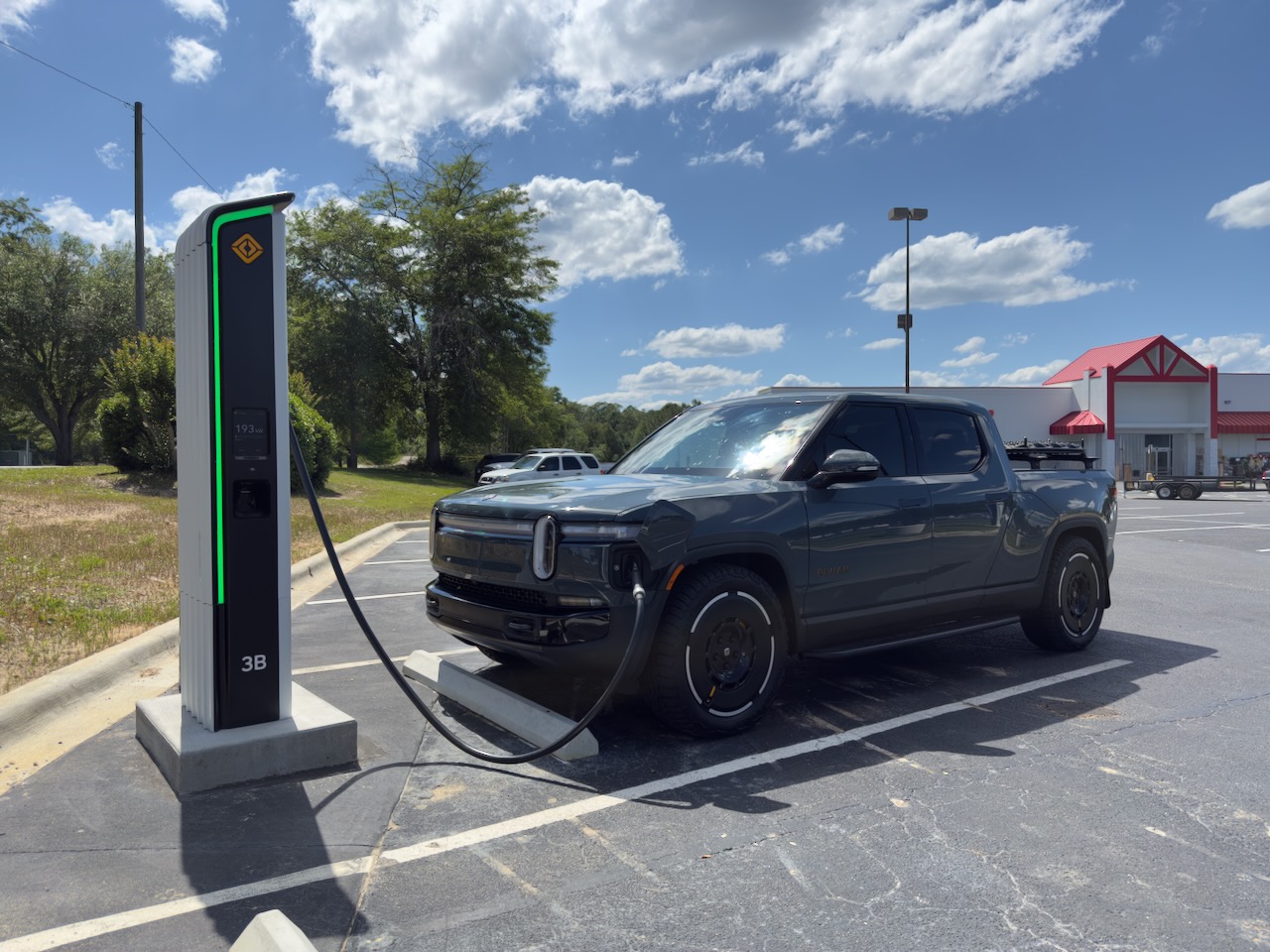
Rivian dropped a new Rivian Stories post this week walking through how the Adventure Network is being scaled ahead of R2 customer deliveries. Most of the post is stuff R1 owners already know, but there is one detail buried halfway down that actually matters. The underground work at most existing RAN sites is already done.
Rivian says the conduit and power capacity at most current locations is already sized for more chargers than what is physically installed today. New stalls can go in without breaking ground or pulling new permits. That matters more than it sounds. Adding capacity becomes a hardware drop instead of a multi-month construction project, which is exactly what you want as R2 starts shipping in volume.
The rest of the post recaps the stuff most owners have already lived through. Nearly every RAN site is open to non-Rivian EVs at this point. The newer cabinets are taller with longer cables that actually reach whichever side the port is on, and Rivian is still working through the NACS rollout alongside the existing CCS1 plugs. Tap to pay is live for non-Rivian drivers now too, so there is no app to download just to grab a stall on a road trip.
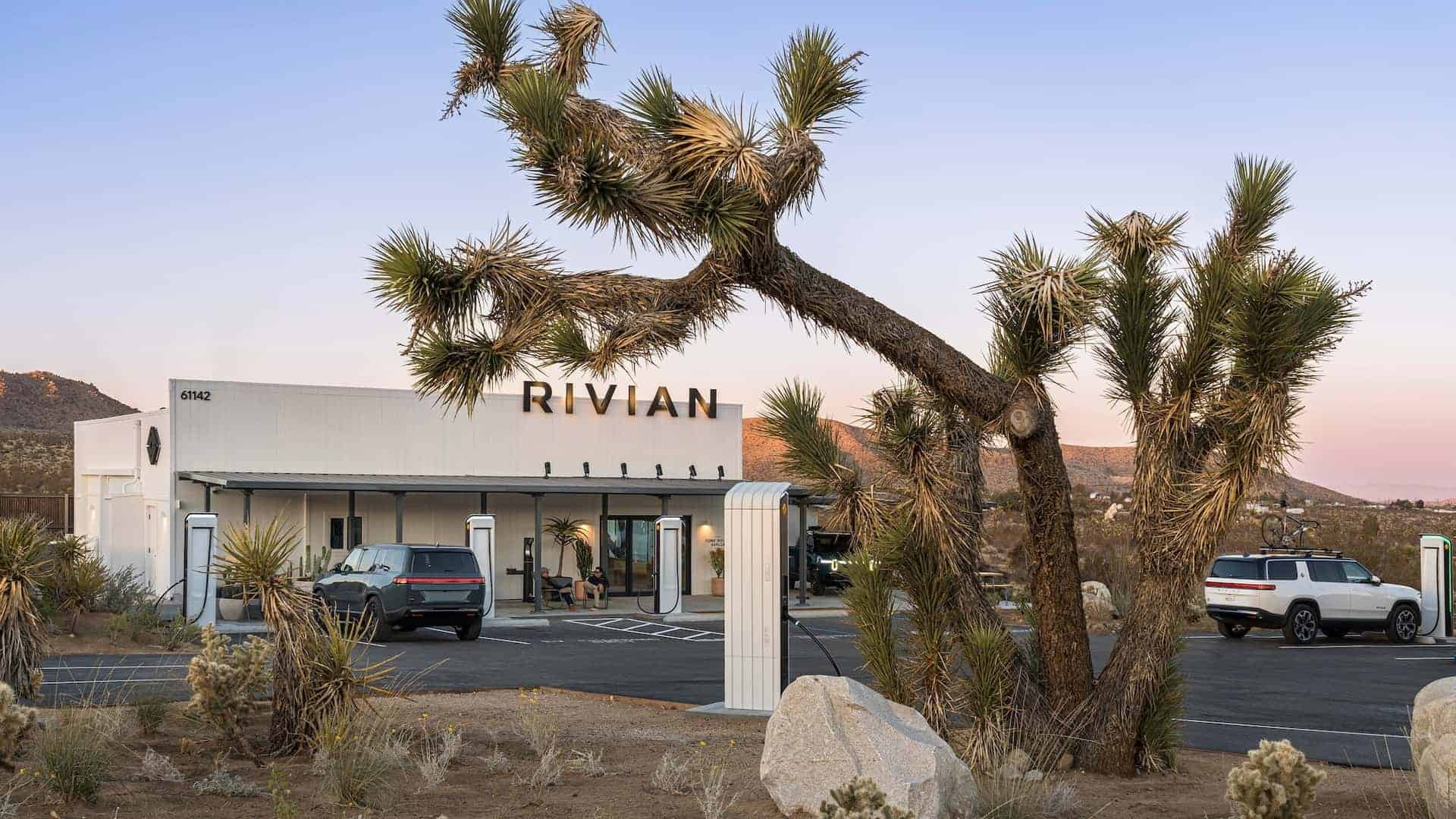
Rivian also reiterated the 98% uptime number from 2025, which has been one of the quieter wins for the network. Owning the whole stack tends to pay off when something breaks at 11pm on a Saturday.
The other thing worth flagging is the tone shift around the broader charging picture. The post mentions nearly 15,000 Level 3 DC fast charging locations and over 70,000 ports nationwide as of early 2026, and frames RAN as part of a wider charging landscape rather than the only thing that matters for owners. That feels like a different posture from where Rivian’s messaging used to sit, when the proprietary network was always the lead.
For context on the size of RAN today, Q1 2026 had the network at 145 sites and 973 stalls, with around 12% of those running NACS. Those numbers should move pretty quickly once R2 deliveries start ramping.
The part I am watching is whether the future-proofing actually shows up in the deployment cadence over the next few quarters. Easy to say the underground work is done. Different thing to see new stalls actually show up at the sites that need them. R2 owners are going to find out either way.



Honestly, the RAN is a bit of a joke from my perspective. I live in eastern Massachusetts and there are at least a dozen Rivian’s in the town I live in alone (honestly, it’s kind of amazing – I see multiple Rivians literally every time I’m out). The closest RAN is over 70 miles away. If you look at a map of RAN locations there are a grand total of 0 in the metro-Boston area and one in Massachusetts in total. There is one in Vermont, two in New Hampshire, and one in Maine, states that have a huge amount of adventure-oriented recreation. The White Mountains, a huge adventure recreational area, dozens of mountains, camping, hiking, skiing, etc. and the closest RAN station is (roughly, it’s a big area) almost 100 miles
I’m not saying Rivian is doing anything wrong, their network they can build it out however they want but talking all about how many more chargers you are adding to your existing locations does not exactly endear me to Rivian more. I’d rather they actually expand the network to places where people need it (e.g. northern New Hampshire) than just add more stations to their existing network. At least I can use the Tesla chargers most places.
The ability to expand existing stations is useful, given the Salida and Del Norte RAN stations that I’ve seen full already, before R2. Other RAN stations that I’ve used seem less busy (Durango, Montrose, Broomfield). Capital efficiency seems key too, so good to see they’re thinking about that.
More chargers at existing locations is only 1/2 the solution. We need more locations.
Doesn’t matter. Clark Kent’s Rivian is bankrupt by 2030.
Well I do appreciate you taking the time to comment on a company that’s going to go bankrupt 🙂
I believe there are only 2 in GA. It seems CA gets more than the rest of America combined.
Are y’all writing off the south?