
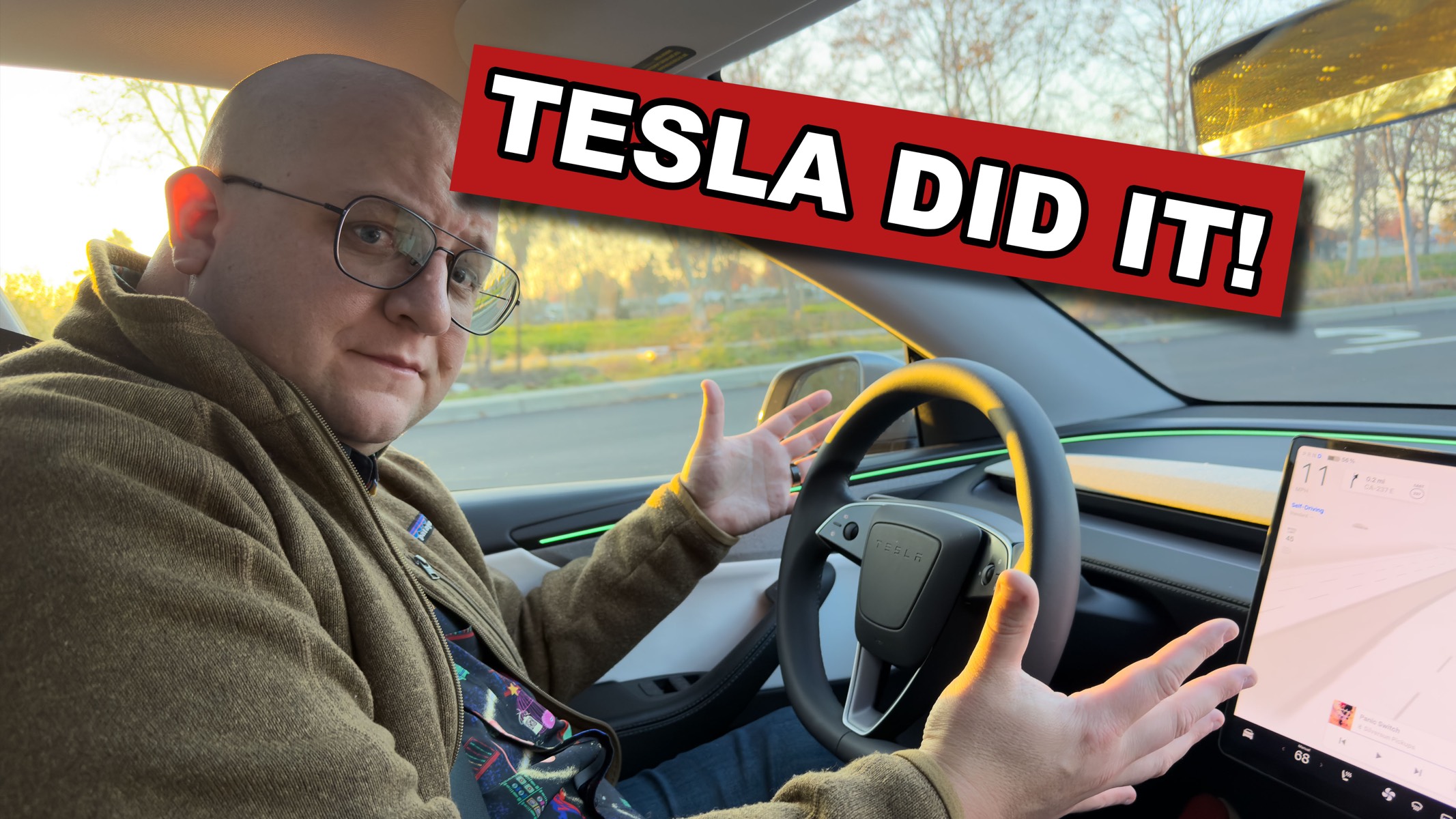
I honestly didn’t expect this.
I haven’t spent real seat time with Tesla Full Self-Driving in years, and as someone who daily drives a Rivian, I figured FSD V14 would be interesting but probably still rough around the edges. I was wrong.
While I’m out in California for Rivian’s Autonomy & AI Day this week, I decided to rent a 2026 Tesla Model Y with FSD through Turo and really put it through its paces. After logging over 100 miles on FSD in a single day, I walked away genuinely shocked at how good it is. The driving felt confident, predictable, and shockingly human in situations where past versions would have struggled.
In the video below, I walk through my full experience with FSD V14, what impressed me the most, where it still needs work, and why this raises the bar for everyone, especially with Rivian heading into a big autonomy moment of their own this week.
Watch the full video below and let me know what you think. Is Tesla officially setting the pace for autonomy, and how big does Rivian need to swing next?



I think it’s great to get a perspective of the competition in the autonomy space. While you’re out in the Bay Area, I’d also recommend taking a ride in a Waymo if you haven’t already.
Agree
The thing people seem to overlook is that true autonomous driving is about statistics: the 5th, 6th and later 9s. If an autonomous car is two-9s, ie in 99% of miles driven, it works fine, but in 1% of miles driven the car is damaged or somebody dies, then it is far worse than a human driver and is a huge legal liability. Getting to 99.9% (three-9s), 99.99% and beyond gets orders of magnitude harder at each step. But that is where autonomous vehicles need to get to before people will trust them.
If you take a test drive in a vehicle that is only 99%, odds are your drive will go great. In fact if you drive that vehicle for a year, you still have good odds of having no issues. But ramp this up over hundreds of thousands of vehicles and billions of miles driven, and the lack of the extra 9s will become crystal clear. And if your vehicle is 99%, and your competition is 99.99%, you lose once the number of miles ramp up and the lawsuits start rolling in.
So while Jose’s data point is a good sign of progress, the real success of autonomous driving will only become clear once large, statistically robus data sets are published. Waymo is starting to do this, probably because they trust that their data show good results.
Swiss Re published a study that showed tenfold reduction in crashes per mile with Waymos versus human drivers, based on a large dataset. If other research confirms this, it may show that Waymo’s getting there (though news reports seem frequent of, say, 3 Waymos blocking a street, with 2 seeming to have bumped each other, or of Waymos passing stopped school buses, or driving through a large police takedown of a felon).
I agree that ADAS providers hoping to get to publicly trusted autonomy need to get to the point of large publicly available datasets. Each 9 is indeed legendarily hard.
I always take the crashes per mile statistics with a huge grain of salt. They are almost never normalized around the population of vehicles on the road. For instance, Waymo should have a much lower crashes per mile than Ford since there are far fewer Waymo on the road than Fords. The higher number of Fords on the road means that there are more opportunities for an accident to involve a Ford. Ferrari probably has a fantastic crashes per mile stat, simply because there are far fewer Ferraris on the road…. the likelihood that any accident involved a Ferrari is vanishingly small.
That’s why I’ve said for a long time that Rivian is decades behind Tesla. Or at least a decade. Right now we basically have cruise control and after December 11… We may have what Tesla had 10 years ago.