
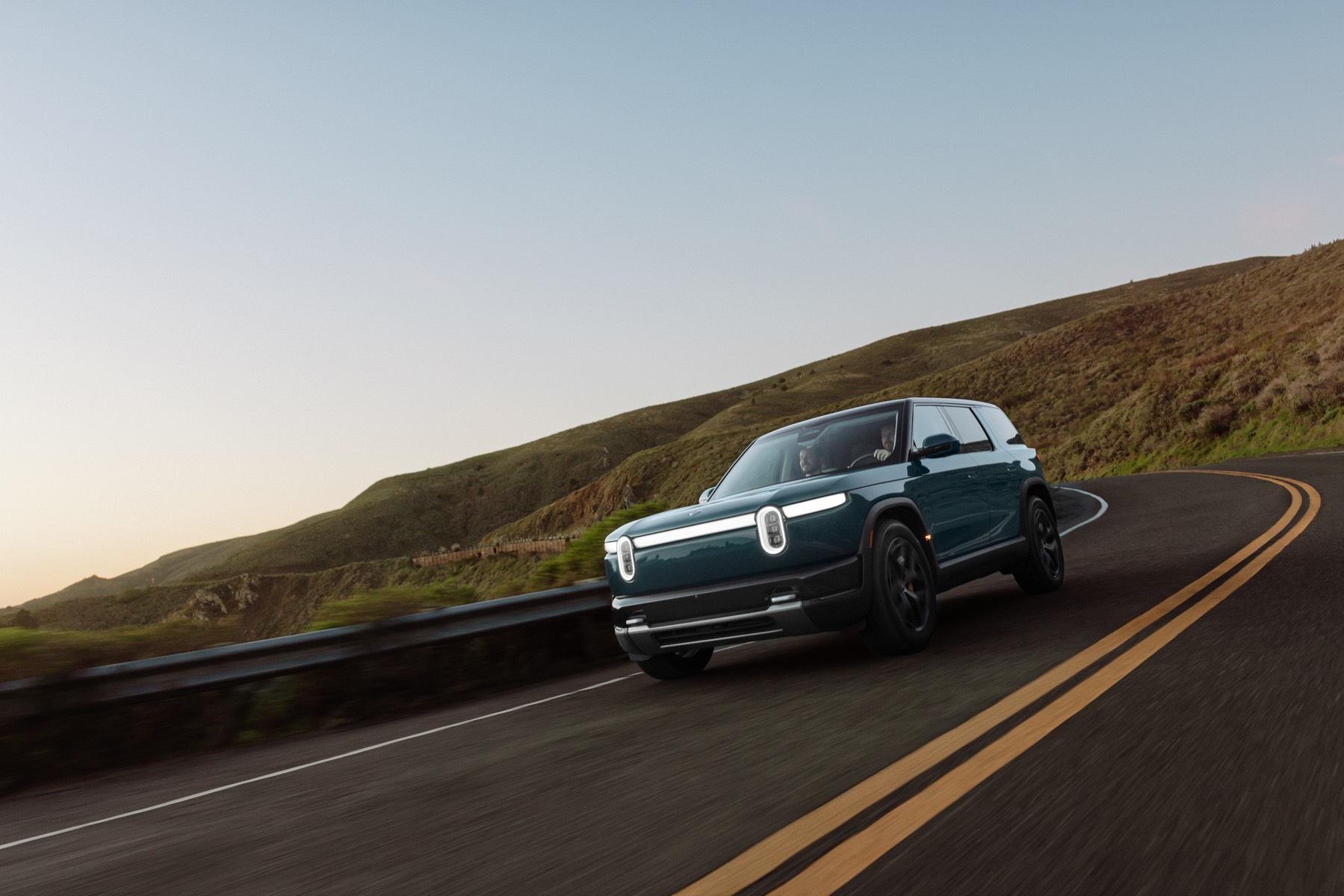
Yes, I’m aware of the irony. We recently spent a few hours running a 70-mph range test with the Out of Spec crew, watched the number tick down mile after mile, and then published it all. So opening an article about how range does not really matter is a little rich coming from me. Our only defense is that we share the data and show exactly how we got there, and what anyone decides to do with that number afterward is not our responsibility.
But the number is not the thing. Or at least it is not the thing in the way when people are sitting in a configurator, deciding between vehicles.
The federal data on how much Americans actually drive is boring and remarkably stable. The AAA Foundation for Traffic Safety runs a survey every year where they ask people what they drove the day before, not what they think they drive in a typical year, and the answer keeps landing in the same place. Drivers averaged 31.1 miles a day in 2024, which isn’t too far from the 29.1 miles they logged in 2023 and the 30.1 the year before that, three years of data, no real movement. The FHWA figure runs a bit higher, somewhere between 33 and 37 miles per day, depending on whether you divide national vehicle miles by licensed drivers or rely on survey responses. Still, even the top of that range is nowhere near 330.
And all of those are averages, which is worth sitting with for a second. An average gets pulled upward by the small group of people driving 200 miles a day for work and by everybody’s summer road trip. The median day is lower than 30. Nobody publishes that number cleanly, but the shape of the distribution makes it fairly obvious once you look at the trip level breakdown.
Oak Ridge reviewed the 2022 National Household Travel Survey and found that the majority of vehicle trips in this country are under 6 miles. Only about 6.9% of trips are longer than 30 miles. An earlier run of the same survey found that of the cars that moved at all on a given day, 93% covered fewer than 100 miles before being parked again. The Department of Energy publishes this specifically as guidance for automakers sizing battery packs, which is a little funny given how the marketing eventually shakes out.
So for something like six days out of seven, the difference between a 250-mile car and a 330-mile car is that one of them is carrying around a few hundred extra pounds of cells it never touches.
Here is where I should be honest about the R2 specifically, because it does not actually present this choice. Every version you can order uses the same 87.9 kWh pack, and the range differences between Performance, Premium, and the Standard RWD coming next year come down to how many motors are turning and what tires are on the car. There is no bigger battery to upsell you. The smaller Standard pack is not arriving until late 2027 alongside the cheaper trim, and that is the moment this conversation gets real for Rivian shoppers, because that is when somebody is going to be standing in front of two prices and deciding whether the extra range is worth it.
There is a fair counterargument here, and I would rather deal with it than pretend it does not exist. That same AAA survey found EV drivers logging more daily miles and taking longer trips than drivers of gas or hybrid vehicles. Whether that is the car changing behavior or just the kind of person who currently buys an EV is impossible to untangle from that data. Honestly, I lean toward it being selection more than anything. Early adopters skew toward suburban households with garages and long commutes. That will probably flatten out as EVs stop being an enthusiast purchase, and the R2 will be a big part of that flattening.
What people are really buying when they pay up for range is insurance against a trip they take twice a year. Thanksgiving. That one drive to see family. Maybe a camping weekend. And there is nothing wrong with buying insurance, except that you pay the premium every single day in the form of a heavier vehicle, worse efficiency, faster tire wear, and several thousand dollars that could have gone toward literally anything else.
The thing I would rather people obsess over is what the car does when you are actually on that once-a-year trip, which is where the charging curve matters far more than the pack size. A car that holds a strong curve from 10 to 80% will get you there faster than a car with a bigger sticker number that falls off a cliff at 45%, because the trip stops being about how far you can go and starts being about how long you are standing around. The number on the screen mattered a lot less than what happened when I plugged in.
And since the R2’s range spread comes from tires and drive layout rather than cells, there is a lever available today that costs nothing. Wheel and tire choice moves real-world range more than most people expect, and it moves it in both directions.
None of which means the range test was pointless. It means the range test answers a narrower question than people want it to answer. It tells you what the car does at a steady 70 in specific conditions on a specific day with a specific set of tires, and that is genuinely useful for planning, but it is not a score, and it is not a ranking. If anything, the more interesting question is what the EPA number is even measuring, which is a rabbit hole I already went down separately.
I do not really expect any of this to change how people shop. Range is the one spec everyone understands without needing to learn anything, and it will remain the headline number for a while yet. We will keep running the tests, because somebody should, and because the alternative is letting the estimates go unchecked.
It wouldn’t hurt if more people, before spending the extra money, went and looked at what their own driving actually looked like last month.



The R2 is the first EV that really checks all the boxes for me. I live in a small rural town 80 miles from the center of a large metropolitan area. The battery and range work fine for me. I think they work fine for the 500 plus mile trips too, but that’s me. I believe part of the brouhaha is because the R2 is attracting so many folks that are ignorant about EVs and they are freaking out about EPA vs. 70 mph range. It is a non-issue if you really look at it.
A great article. It’s the same stuff I’ve been saying in reddit forums for a while, and so have many others. I think people are starting to figure this part out.
One thing I’d like to see is an article on what people do when charging. I think most who haven’t had an EV think of it like they’re basically sitting at a gas station for 30-ish minutes. My family takes a road trip to Minnesota every year, from WA state, 4500 miles round trip once it’s all said and done. We have found that the charging stops have turned into mini adventures that often end up being a highlight of the trip. New local restaurants, cool local shops, etc. I’d really love to see a study done on what people do at their charging stops, and an article on it.
The range coming in at around 250 on a 70-mph test for this vehicle is pretty much on par with what I would have expected. I would think most of the people who are bothered by that are likely someone new to the world of EVs. This is not something that would hold me back from going forward with an R2.
Great editorial. I have progressed from a 2020 MYLR (my first EV and it only took one test drive to convince me to buy), to a 2023 HW3 MYLR with comfort suspension (so much quieter and smoother) to a 2026 Premium AWD with FSD (got the free license transfer from trading the 2020), which my wife and I utilize 94% (interventions for some quirky navigation in my neighborhood, plus parking). But I have an R2 reservation that I’ll exercise next year when LiDAR and RAP1 upgrades are available. Why? Roadtripping isn’t a priority (I’ve only used a Supercharger maybe a dozen times in over 6 years); the R2 demo drive showed me how solid, quiet, comfortable and planted feeling the R2 is over the Juniper. I like the higher driving position and visibility, plus the larger and better shaped storage room is much more convenient for hauling bulky stuff. As great as FSD is, I think in a couple of years Rivian’s Autonomy software will equal and possibly surpass “eyes off” Unsupervised FSD due to the extra sensors. We’ll keep both the R2 and the Juniper for many years (into our 80s as long as we are allowed to keep our licenses). We’ll have the best of both.
Range doesn’t matter, but having realistic expectations on the drivable distance between chargers does. Anyone who’s owned an EV knows to take the range calcs, and even the SoC displayed on the dash, with a grain of salt. There are too many variables that impact EV efficiency.
My 23 Mach-e GT has never taken me from 100% to 0% for the advertised 270 miles, but I wouldn’t even want to really test that. I recently took it on a trip from Denver to Maine and back, 4k miles RT. The longest distance between charges, which I max at 80% on DCFC, was 171 miles. I’m looking forward to getting my R2 for a lot of reasons – more space for stuff, a better ride and suspension, and modern tech. I’ll still stop every 2.5-3 hours to stretch and pee. And with the R2’s better charging curve, I can be on my way much sooner.
I’m an R1 owner so this R2 is not my normal cup-o-tea. I drive too many miles. 9 months into the R1S and it’s got 30k. Lots of road miles, about 25 DCFC sessions in the 20%-85%. One recent session from 5% to 80% at a Ionnia DCFC in middle Illinois. The rest of the charges are L2 30-50A. This is to say the battery drain is erratic by season but far more accurate and seemingly better as time and patches get delivered. I get all the range expected which is to say, all the range advertised on sale IN THE SUMMER. Winter ranges very wildly but most of all with the wind/snow push, tire selection and cold.
One last thing about this range conversation. It is the same range conversation for a petrol-powered vehicle, except when the EV freezes, it still starts, drives and heats much more quickly.
Thank you greatly for the context. If people only wanted what they really need, 99% of the World’s problems would be solved, or wouldn’t exist in the first place…
Great points, Jose.
It’s not until you’ve been L2 refueling your car at home for a while that you begin to think differently about local driving and range. And it takes a few longer trips before you get a feel for how well a car like R2 does on ~2+ hour driving segments with a DCFC stop. A bigger battery is always nice in theory but until battery energy density takes another big step, it’s not worth the weight and the cost for bigger ones. Rivian has struck a good balance.
I’m a fan of Rivian and I have a R1S with a max battery. While I appreciate the point of your editorial, I think a 70 mile range test where the range is only 250 miles is not acceptable for a vehicle like the R2. The range test was done during the summer in ideal conditions. I can’t even imagine what the range of the R2 will be in the winter. To me this excludes considering purchasing an R2.
Appreciate the thoughts. Certainly a nice summary of concepts that others have shared in other settings etc.
As an r1 owner with an 70-90mile daily commute, having the range of a max battery means home charging every 3 days instead of did every 2. Major issue, no. But an extra task to do each morning/evening.
I admit I wish there was a r2 max. Would pay for it.
That being said, I’m disappointed that real work range is so dramatically lower than advertised. Small difference would be acceptable but losing a quarter of the range you thought you paid for sucks.
My take is that each person needs to analyze their actual driving habits to make a realistic range decision. I’ve had my R1T dual max for about 18 months and put 25,000 miles on it. So yes – on average I’m in that 30-35 miles per day range. But my driving also includes 2-4 200+ mile round trips per month into an area of the state that has very few viable charging options. I wanted enough range to make that trip without charging in summer or winter.
A couple of Level 3 chargers have now been installed on that route so in some ways the pressure is off, but I’m still very happy with the max battery decision. On actual road trips the extra range lets me comfortably drive 3-4 hours without needing to wait for a charge above 80%.
Time to charge has always been a more important metric to me than range.
I tell everyone who’ll listen and is looking to buy an EV:
Reset your trip odometer then drive for a day or two. Take that number and add about %30 for winter loss and use it as your baseline for what size battery you should get. The longer you think you want to go between recharging would determine how long you let the trip odometer run…It’s not perfect but a lot of ppl are surprised at how little mileage they actually drive vs. how long they sit in the car in traffic.
If you take a trip 1 or 2 times a year consider getting a rental for the trip. That way you are putting mileage on a rental and can get a monster SUV to haul all the family/pets/stuff that you may need (and don’t cart around on a daily commute).
I have considered doing just what you are saying. We currently have an EV we use all the time for commuting and local trips, as well as an older Explorer as our family car. It would be great to have a larger SUV like an Expedition for the 1-3 long road trips we take a year, but is wasteful to have for the other 50 weeks of the year in terms of price, gas, and just having to maneuver a monster SUV everyday. I’m considering getting a second EV and then renting an expedition for about $800 a week with the gas and upfront savings…
I am disappointed in the range result but unlike say 8 or 10 years ago this range is fine. Thanks to companies like Tesla, Ionna, Rivian and now Walmart there is so much DC fast charging available range is not a concern. Unfortunately people often buy vehicles based on 5% of their needs. How often do we see one lone person sitting in an empty full size SUV or pickup. I feel they really needed to get over 300 miles at an average of 70 mph.
Good article.
I came to the point that after 2020 EVs are the best daily drivers. When it comes to range, I just need 150 miles for my daily commute and driving around my area. The current EV that we have has a battery of 42kw (abt 153 miles) and it get’s the job done. There are times we have done some long drives with it in the state that we live in and I don’t worry about charging because there are so many DCFC stations long routes we take.
“So for something like six days out of seven, the difference between a 250-mile car and a 330-mile car is that one of them is carrying around a few hundred extra pounds of cells it never touches.” – This quote is something similar that I have tough about in the pass.
If you want to know your real number of daily driving or how much you drive in a week/month just reset your Trip Computer.
If there wasn’t a market for EVs with longer distances, car companies wouldn’t build them. Don’t apologize for the R2 having an uncompetitive range.
My R1T DLP has, at best, gotten 2.4 mi/kwh on TX road trips. That gets me ~265 miles of range, which if I’m trying to drive 80%->10%, gets me 184 miles between charges. In TX at ~75mph that means I’m stopping less than every 2.5 hours and that assumes that a DCFC is conveniently placed at those intervals.
You’re also forgetting that the biggest money saver on an EV is home charging. The less DCFC I can do the more money I can save, not to mention the convenience of having to stop less or stop based on my needs, not the car’s.. People are rightly frustrated that a net new EV from an EV only company has less competitive efficiency, charging speed, and battery capacity vs legacy luxury options that can be priced within $5k of the R2. Rivian has an R&D spending deficiency and it is showing here.
I have a R1T ( farm truck yes I’m bougie), but having 1000+ horsepower for hauling items that my F350 dropped to 8 mpg and only loosing 35 % of my battery to 9000lbs of trailer n water, or trailer n backhoe. I absolutely love it in the farm. 4 charging stations 40 miles away, charge at home. I have put 8047 miles on it in 6 weeks.
I also have a Ioniq 5 sel. We have put over 130,000 miles on it in 3 years. Long trips short trips.. you name it. I no longer have fear of charging/ hate for charging.. it is what it is.
As for the long trips I think the overlooked item here is that if I’m on vacation I’m not rushed, I am picking hotels and places with free overnight charges, and lastly I enjoy not smelling ICE components/noise.
What I have learned over the past eight years daily driving a launch-edition 2018 Model 3 (and it doesn’t seem to have changed much, at least not in the US, since then) is that current EVs are in an awkward spot. They have too much range. And also, they don’t have enough range.
As pointed out, day to day you don’t need more than like 100 miles of range (accounting for using the middle 40% of the battery, running from 70% to 30% on a daily basis is best for battery longevity). Call it 150 miles because some days you just need to do a lot more driving. If EVs could target 150 miles of combined city/highway range, they would be cheaper, lighter, and more fit for purpose.
Road tripping is a different animal. You really want around 400 miles of real world highway range. That way you can really chew through the miles between stops using 10-80% (or 5-70%, or whatever). You can go faster and stop less. At around 253 miles running 100 to 0, you’re looking at a roughly 170-180 mile hop to run 80-10%, and that is just not long enough to make for a good experience on a long road trip.
It seems like the best option is to own two cars: a commuter and an all-rounder. People already do this, buying an econobox to drive to work, and a family hauler for everything else. The problem is, at least in the US, a commuter-optimized EV doesn’t sell, and a great road-tripper is too expensive. So we are stuck in this weird limbo, with cars that aren’t optimized for anything.
I look forward to a future where battery tech improves and prices come down, so we can at least have a true road trip car. And maybe, at some point, we’ll have good commuters, too. But the buying tendencies of the market will have to shift for that to occur.
So, there is much truth to the “don’t buy at ev for a trip you take twice a year” argument. BUT, for Rivian, I believe this to not be true. Its an adventure vehicle. Its why I want it versus a sedan EV. And by its very nature, it is meant to be taken places besides going back and forth to work and on errands.
The beach, mountains, etc. are generally not places with a lot of EV chargers. So, range becomes very important.
I’m only considering the R2 because I want to drive in the soft sand in OBX. Period. Otherwise I would just keep my 2018 M3 Mid range. It gets me back and forth in my daily life perfectly. But, I want to vacation in OBX a few times a year as I get older and closer to retirement. So, I want something that can do that. And if the R2 does not have the range to do that comfortably, it becomes a dealbreaker.