
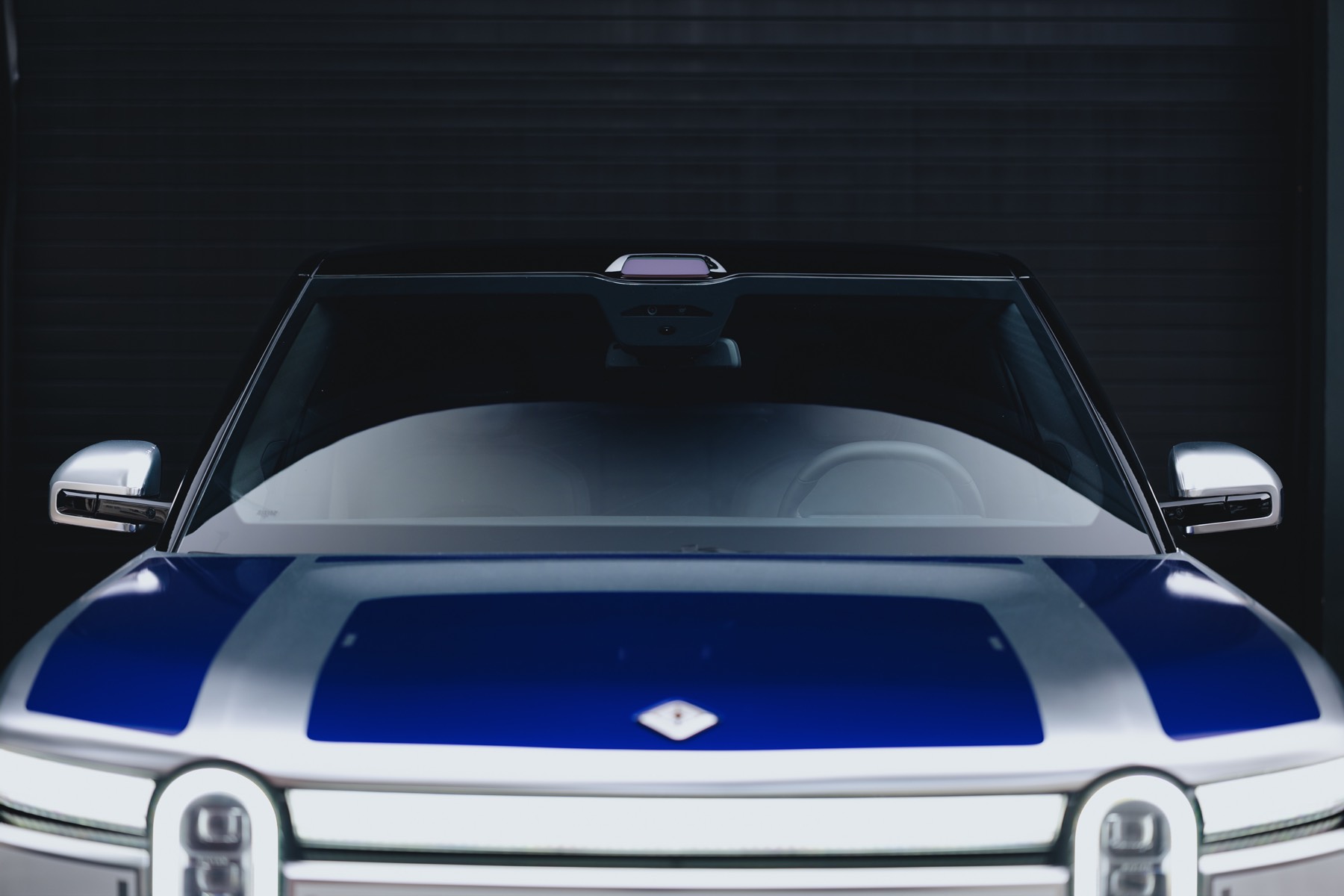
Editorial: This piece reflects my personal opinion as an R1S and R2 owner. Rivian still plans to launch LiDAR on R2 in 2027, and nothing here is based on insider information about its plans.
Update (October 5, 2026): Added context on Tesla Robotaxi’s night driving limits and Rivian’s use of radar.
Rivian’s LiDAR-equipped R2 won’t reach customers until 2027, and after putting plenty of hands-free miles on my R1S and R2 with cameras and radar alone, including a lot of my 2,500-mile drive home from Normal, I’m not convinced LiDAR is necessary for Rivian to succeed in autonomy.
Chip Newcom told investors last week that RAP1 and LiDAR will go into employee R2s later this year before rolling out to customers next year, with the sensor now costing Rivian only a few hundred dollars. Rivian still hasn’t said when or if LiDAR comes to R1, and non-LiDAR R2s like mine won’t get a hardware upgrade.
The case for LiDAR is that it measures depth in any lighting, and Rivian argued around Autonomy and AI Day that Tesla’s cameras alone aren’t enough. The other side is that every extra sensor is one more input the software has to sort out when they disagree, while camera and neural net driving keeps closing the gap. Rivian has even said data from LiDAR cars will help train the models running on vehicles without it.
Dropping LiDAR still wouldn’t put Rivian in the same spot as Tesla, since Rivian uses radar alongside cameras while Tesla runs on cameras only.
Musk famously called LiDAR a crutch, and for years that sounded like stubbornness to me. Watching Rivian’s LiDAR timeline slide while camera-based driving keeps improving, I keep coming back to the thought that maybe Tesla was right all along.
Musk complicated that this weekend when he explained that Tesla Robotaxi’s hours only moved from 10 PM to 11 PM because the cars still have trouble seeing pets on dark pavement at night. That’s the low-light scenario LiDAR handles best, and radar is weaker on something as small as a cat, so I can see LiDAR earning its spot on R2 for night driving.
I fully expect LiDAR R2s to ship in 2027, but I think Rivian eventually drops it across the lineup, R2 included, once its camera and radar stack proves it can handle eyes-off driving on its own. Let me know in the comments if you’d wait for a LiDAR R2.


If LiDAR is a crutch, then someone tell Waymo and every other robotaxi company that’s got a massive LiDAR rig on every corner. Simply put: more data is always better.
The way Musk used it, a “crutch” is just a pejorative term for a very useful tool that he happens to dislike. If I have to drive a nail into wood, a hammer is just as much of a “crutch” as LiDAR is for AVs.
More data definitely isn’t always better..Lidar and Radar are a useless menace in certain weather conditions such as rain, fog, snow and heavy dust.
Tesla’s Camera based vision system has proven beyond a shadow of doubt that even more important than the sensors is the vehicle brain and Algorithms developed from neural net training from now 15 Billion miles of Tesla real world driving data.
No Autonomous driving manufacturer on Earth has invested the Billions of dollars that Tesla has to not only develop the most sophisticated hardware for their vehicles in the Ai vehicle brain and sensors linked with the most advanced EV vehicle software and platforms, all supported by the largest Ai Training facilities of any Auto manufacturer on the Planet..
Tesla remains leagues ahead with it’s FSD Autonomous driving platform and the gap is only widening..It’s nearest competition is Xpeng..but even their CEO has publicly admitted Tesla is the Gold Standard and leader in Autonomous vehicle systems.
Wow, lots of opinions, but seem to be lacking in facts and credibility to make such claims. You seem to spend more keystrokes touting Tesla than keeping to the discussion topic.
“… useless menace…”? really? Check your facts on the rain, fog, snow conditions.
I agree. Lidar is good is all weather. Rain and fog affects cameras more than lidar. Radar is nothing more than a speed tool IMO. Not much help. I think a night vision sensor would be better than radar but then again that’s only my opinion.
You’re like two decades behind the times. Lidar works in precipitation, it even works in smoke and fog. Not sure where you got your info from, but, yeah, extremely out of date here. Also, while we’re just spitballing, tell me again how a visible light camera sees through fog, smoke, and dust?
“No Autonomous driving manufacturer on Earth has invested the Billions of dollars that Tesla has”
Gonna go ahead and stop you there, and point you at the dozens of companies that have.
“Tesla remains leagues ahead with it’s FSD Autonomous driving platform”
Waymo.
“Tesla is the Gold Standard and leader in Autonomous vehicle systems.”
🤣
Ok FanBoy, why is Tesla then massively behind Waymo in its rollout and reliability? The Tesla cars are still teleoperted when they get into issues on the road. Yes they’re making progress but it’s much slower than they expected and it doesn’t work in low light.
Just because it’s been delayed for whatever reason doesn’t mean it’s not needed or worthwhile. I prefer to trust radar / lidar vs cameras only.
Lidar isn’t a crutch it’s a cheat code. Using active sensors to directly measure centimeter accurate distance lets the system spend compute on decision making rather than trying to solve AGI just to estimate depth from 2D pixels
So when the sensors disagree and the cameras are wrong I guess you can just ignore the Lidar and slam into the wall. I hope Rivian finds a better solution.
I understand your point, and thanks for all your coverage so far. I wanted to mention something to bolster your third paragraph. Elon actually just said that Cybercabs don’t operate after 11pm to help prevent incidents in low light. He said on X “Literally trying to avoid grey kittens on grey tarmac in the dark.” I think this is exactly the type of situation that a multi-sensor setup is meant to solve.
There could definitely become a point where the neutral networks are developed enough to reliably resolve fine, low-light detail without any additional sensors. But for now it seems like LiDAR, whose big strength is handling edge cases, is still necessary for L4 at all times of day
I’m pretty sure at the 2025 AI day they said the primary use of LiDAR would be to accelerate the digital model/ AI training process. I don’t think Rivian has near term plans to use the LiDAR sensor in the day-to-day self-driving of individual vehicles but eventually hopes to use it as a redundant sensor. I feel I should also point out that Tesla still uses Lidar to calibrate/validate its camera-based driving system. In the end Rivian will have a massive LiDAR validation fleet for camera-based driving which they hope will help them rapidly close the gap on Tesla.
Correct, for the initial launch LiDAR will be used priamrily for ground truth and fleet collection that will then benefit all other Rivian R1 (Gen 2) and R2 owners.
If they drop lidar does that mean the current Gen 2 R1 models could be getting L3 and L4 autonomy?
Traffic Engineer here – Waiting for LIDAR.
Def not waiting for “Lidar”
I think for now a single focused system is the way to go. Even Tesla is cutting planned memory on its ai5 and ai6 chips. So I imagine there will also be problems with producing processing chips to meet the demands of AI, self-driving eevs and a host of other upcoming advancements. For now, keep it simple. Keep the cost down and wait for manufacturing to come to fruition. Then you can start investigating combining systems like lidar and cameras
It would be interesting to learn how much LiDAR improves over radar and cameras in low light situations. I’ve read that radar is better when there is precipitation and LiDAR is better in low visibility for spatial mapping. Personally, I’d wait and pay a bit more for the LiDAR especially given the recent reports of issues with comma.ai. I’d rather have 3 live sources of data, plus historical, and my own eyes rather than just relying on cameras and radar.
I think Rivian will keep Lidar. Rivian has already talked about how self driving is not really real until the liability shifts from the owner of the vehicle to the manufacturer. Rivian will want every advantage to lower their liability.
Mr Musk says lidar is a crutch? Hardly. Mr Musk’s personal wealth comes mostly from Tesla. He’s just a cheapskate who views spending money on lidar as money out of his own pocket. Cameras (which the con man calls vision) alone are not enough, which is why Tesla has been stuck at level 2 for a decade. I have no doubt Rivian’s products with multiple modalities of data collection will match or exceed autonomy offerings from competitors in the next two to three years. Musk has no idea how human vision works, by the way. The word vision for him is just another con for the gullible.
I’m confused. At last year’s autonomy day, Rivian highlighted the importance of LiDAR. They shared screenshots and videos demonstrating that camera + radar + LiDAR delivered superior vision capabilities. They had engineers describing the addition of LiDAR as a no-brainer. With LiDAR currently unavailable in their vehicles, the messaging has shifted to LiDAR only helping them train their models, that LiDAR will not deliver better self-driving on their vehicles for the foreseeable future. How do I reconcile Rivian’s messages from last December on the importance of LiDAR against current messaging that it’s not important?
Rivian believes LiDAR is necessary for eyes off/L4. It’s not necessary for the level of autonomy they’ve introduced currently, which is not the same as it being “not important”. I think they also believe it will make their L2/L3 offerings more robust/safer; nothing wrong with setting the bar for safety higher than is required by regulation. They haven’t walked back any of the statements they made last Autonomy Day.
Why would we limit computerized drivers to the same limited set of senses that we happen to own as humans? Do we limit the number of cameras to two because we have two eyeballs? LiDAR is clearly very useful and helps where vision fails. I wouldn’t mind having thermal sensors and anything else that could help.
As human drivers we often feel uncofortable driving at night, especially when it’s raining. We know it’s not really safe and we can feel that we barely see. I don’t want the same limitations when I’m sleeping in my self-driving car in 2040.
This whole discussion started because of cost-cutting that Elon Musk wanted to disguise as wisdom. There is nothing more to it, really. If the cost is not a problem, this discussion is not even needed, anymore.
The wonders of the human anatomy and brain is that your brain can take the signals it gets from you eyes and turn it into a work of art full of depth. We live in a 3D world and cameras see in a 2D world. LIDAR adds to what cameras can’t.
Many states are working on regulations that will require sensor fusion for any self driving vehicles. Vision only will remain a drivers assistance feature. I have a FSD Model Y and I will never trust it to always make the right decision. I’ve seen it make terrible decisions too many times she to sunlight reflection and other contributing atmospheric / light conditions.
A few things:
1 there is an ongoing NHTSA cybercab investigation asking how Tesla can self-certify that it has all the things a passenger vehicle has without a steering wheel or pedals. In fact, the official guidance they gave to first responders is to push it out of the way.
2 it is disappointing that it doesn’t appear that customers are going to get a clean cut guidance on if their vehicle will deliver with Rap1 and or LiDAR. Not surprising that RIVIAN hasn’t learned from other deployments but… yeah
Why would we not want as many layers of protection as possible? Due to the low cost, it now appears the only argument against lidar is that it MIGHT cause confusion for the system. Based on the empirical evidence I’ve read, that hasn’t happened for Waymo and they use the 3 sensor suite Rivian plans to use.
Unless there is clear evidence that lidar causes issues, it would be dumb to scrap it. The cost is low, and we know it will help Rivian gather data and mature its self driving program. Plus it will simply make people feel better knowing it’s there. Just reading all the comments here is proof of that.
Even if it creates an overly cautious self driving experience I’d way rather have a random, seemingly useless, slow down while driving than the thump-thump of someone’s kitty because we didn’t have lidar to catch it.
It hasn’t been delayed. “Shipping” doesn’t specify non employee customers.
For those of us who own Teslas and have experienced near heart attacks when FSD doesn’t see a kid on a scooter and almost hits him or almost hits a large bridge support post because sun glare blinded the cameras. In both cases I can use the word “almost” because I had to take over, otherwise FSD would have hit the kid, and the bridge support. I would never drive or be a passenger in a vehicle that doesn’t have radar and Lidar for L3 & L4 autonomy.
The question is if Rivian is ever going to deliver on Lidar or if this is going to be the same delay game that Musk and Tesla play
You’re engaging in dangerous black and white thinking here. It’s not a simple, binary case of necessary/unnecessary, it’s how many lives are saved. If LiDAR saves 1,000 deaths a year, how much is that worth? Now ask the same question for it preventing the death of one of your loved ones.
Musk’s argument that more types data that allow higher statistical confidence in a perception system will “confuse” the system shows a lack of understanding of how sensor fusion works. The price is not worse disambiguation (the opposite is true), the price is a higher bandwidth and computational load for the low-level processing.
His biological analogy is weak. Humans did not evolve to drive vehicles in complex environments. The 40,000 road deaths per year in the USA alone are testament to that. Autonomous vehicles have to do much better than that because each death is a media event, and failures can often appear foolish to humans (human’s just fail in other foolish ways).
As someone one said to me, if Musk believes in the biological analogy, why don’t his cars have legs?
“Success” depends on the target. Is is a two- or three-9s system that is about as good as a human? Or a five-9s system that is far better than any human ever could be? The former is almost certainly achievable camera-only. The latter almost certainly is not. Will any current system achieve the latter, and at “reasonable” cost? Time will tell. Also keep in mind that each extra 9 of reliability is an order of magnitude or more in complexity. Just ask Waymo.
I didn’t wait for Lidar because the launch package was too compelling to ignore. I would rather get $3500 worth of free stuff than wait for something whose promise may never materialize. Rivian seems to think they can get to personal L4 with the gen 3 suite, but Tesla thought they could get there with their Autopilot 2.0 hardware suite that they shipped in 2016, and we are still waiting, three generations of hardware later.
I hope my car will eventually get eyes-off, even if it can’t drive without me in the driver’s seat. But even if it doesn’t, I will still be happy to have saved the money I saved by not waiting.
There is an unbelievable amount of FUD on the internet on this subject, thanks to Musk and his troll army
Musk has (incorrectly) convinced many people that adding LiDAR produces noise, while adding an additional camera does not. This is false.
All sensors do is produce data. There are no “photons” used for inference as Elon often likes to tweet. Light hits a digital sensor in a camera which gets converted into data (large streams of ones and zeros).
Guess how LiDAR works? Light hitting a digital sensor which gets converted into data.
The primary difference between the two is that a camera captures color and brightness information. And a LiDAR is capturing timing information of the light that its own precise sensor is emitting. That timing information allows it to generate the 3D point cloud with precise distances.
So adding additional camera sensors also produce all kinds of noise. There are literally too many examples to list. But some would be: dust or dirt on the camera covering, weird sunlight or lens flares, or resolution that is too low to make out accurately an obstruction.
It’s the job of the inference model to ignore as much noise as possible and rely only on the signal to produce a trajectory. The only thing adding additional sensors do is incrementally add compute pressure and memory pressure by creating the need for a larger model.
Whether any manufacturer is using LIDAR or not, they’re going to have noise in any sensor they use
I don’t want my self driving vehicle to be ‘better than the average driver’ ala Tesla. I want it to be as near infallible as it can possibly be. If I’m gonna spend $2,000 for my chosen paint color (and I am), I can certainly pay a few hundred for an extra measure of safety with Lidar.
LIDAR and RADAR both give additional sources of information. Cameras can’t see thru heavy rain or fog or in the dark.
Also, according to Google (AI mode), multiple types of sensors can significantly reduce the chance of AI “Hallucinations” but it does require more compute power. The launch edition is tempting but I’m pretty sure I’ll wait for the RAP1/Lidar version
google AI session: https://share.google/aimode/eqM86knkVu9uT1geq
The R1 has an underrated advantage over Tesla here: forward-facing cameras in both side mirrors plus the windshield camera. Cameras spaced that far apart could do wide-baseline stereo, which measures distance directly by triangulation rather than inferring it from a single image. At that baseline, range accuracy can rival lidar, and it’s a software upgrade, not a hardware one. The catch is calibration: mirrors flex and vibrate, so the cameras have to be realigned continuously in software. Solvable, but it’s why most OEMs haven’t tried. (Disclosure: I founded NODAR, which builds exactly this.)
Jose, I bet you don’t live where there is snow in the winter and dense fog every once in a while. I’m looking forward to the Lidar after going through both experiences slower than I would have liked.
I hate autocorrect!
Musk was partially right. In 2019, the available radar was too limited to be useful for locating objects. And Lidar was too expensive for a mainstream car. Cameras were the only available option.
Where his opinion was .. questionable .. was in claiming that cameras were sufficient, because people drive with vision only. If the goal is to “only” continue killing 40,000 people every year on American roads, then sure, vision is sufficient.
Lets get to the real topic: sensor fusion. Waymo Ojais imaging radar is not as accurate as lidar at pinpointing direction and size of an object, but the specs look good enough to continue driving in heavy rain, at an appropriate, slower, speed. When the lidar data can’t be relied on.
R2’s forthcoming radar isn’t quite as good, unfortunately. But it is still vastly better than no radar, or older radar. And better than most cars’ Automatic Emergency Braking radar. Should be a good safety addition. Great for L2++ driver assist. Probably good enough for L3 on mapped highways.
L4 everywhere, on a consumer car? We’re still a few years from that.
Jose, is it difficult to add an Upvote/down vote button to comments?
This article makes little sense. For one, why do people keep saying lidar timing slipped when it didn’t? It was never promised to be in every R2 in 2026, full stop. Just stop already with that.
The article makes the exact points for why Rivian needs lidar while at the same time saying it doesn’t need lidar. Lidar has never been about anything other than L4 autonomy. I mean, it also will help train the LLM fast we well but that is besides the point. Musk says their Cybercab is still having issues with seeing things at night. Yep. What he didn’t say is worse, it’s still having issues in plenty of edge case scenarios where lidar almost certainly would have solved the problem already for them. Then you have the regulatory issue. At the end of the day, before there are millions of L4 cars being driven all over the place, regulators have to sign off on this. How can they be satisfied these cars are safe enough? Redundancy. That is what lidar offers. It isn’t good enough that it does a great job 99.999% of the time.
Rivian absolutely needs lidar. Having said that, if all you care about is L3 and are fine not having L4 in 2029 then, yeah, lidar means nothing to you. Yet plenty of people are still “holding off” on buying the R2 because they simply aren’t listening and understanding this. The need for lidar will be very evident when your R2 is able to continue driving itself at 2 am in a snow storm while the autonomous Tesla’s have all pulled off into a parking lot while they wait for better conditions.
Tesla made a decision they HAD to make. They were trying to build out mass production when LIDAR sensors cost $5k-$10k. They’ve built a VERY impressive (and still the MOST impressive) FSD system out there without LIDAR.
Now LIDAR sensor systems are miniaturized, and available at a fraction of the cost (I’m hearing less than $500 now). Meanwhile, computational power and AI models have continued to accelerate.
I think it’s more likely Tesla integrates LIDAR at some point than Rivian drops it. There just won’t be any reason not to.
Elon has reversed course when his decisions get pushed too far to the extreme (case in point – removal of the turn signal and steering yolk). Eventually common sense does prevail, but his stubbornness has obviously overall been very good for Tesla and all his other companies.
I’m struggling to understand Jose’s argument except for Tesla seems to be doing fine. Plus “watching Rivian’s LiDAR timeline slide” is odd given they just announced end of last year and are on track to deploy end of this year.
There is no way all regulators (local and overseas) will allow camera only AD. Rivian have made the smart move which will increasingly become obvious over the coming months and years.
For sure you don’t need LiDAR in every situation, but it’s kinda necessary to protect dumb humans from themselves who will try to use autonomous driving in conditions not suited for just cameras. Cameras and algorithms will indeed improve over time, but having more inputs isn’t a bad thing, and down the road when advances potentially make this hardware obsolete(if ever), you can make the case to remove it from future Gen releases.
With all due respect José, who the hell are you to editorialize on such an important and technical issue. I like hearing your thoughts about losing the cooling fan in the R2 seat back. I could care less whether you think LiDAR is a good idea or not. You do great work here overall, yet not with advocacy pieces like this.
Lidar is a “crutch” because it is a quick way to train the AI system, and it can allow the programmers to be lazy and fall back on Lidar this comes at a cost though, not only the lidar module but also more processing and memory. Lidar becomes very useful in some fringe conditions like blinding light and very dark environments…but it is not practical to install a 360 lidar array in a passenger vehicle so in Rivian’s case it will likely only serve as a way to safely allow the driver to take over or pull over and stop the vehicle in environments where the cameras can not provide autonomy.
I’m leaning towards waiting for Lidar, not because I think it will immediately increase self-driving capabilities (it won’t, and Rivian has said as such), but because I believe it will, from the get go, deliver a safer driving experience with the “auto-braking” object detection etc during an emergency situation, especially in low light, low visibility environments. I live in a somewhat rural area in a “dark sky” part of the country. Driving at night here is usually pitch black with deer/wildlife always around.
I may be wrong but it seems as if having an extra sensor suite, especially one as precise as Lidar, can only help with avoiding unwanted object/wildlife collisions.
I’m waiting for LIDAR – merely becuase it comes with the RAP1 hardware.
21,152 mi here FSD. Two minor interruptions. I would say that’s a good case for Tesla