
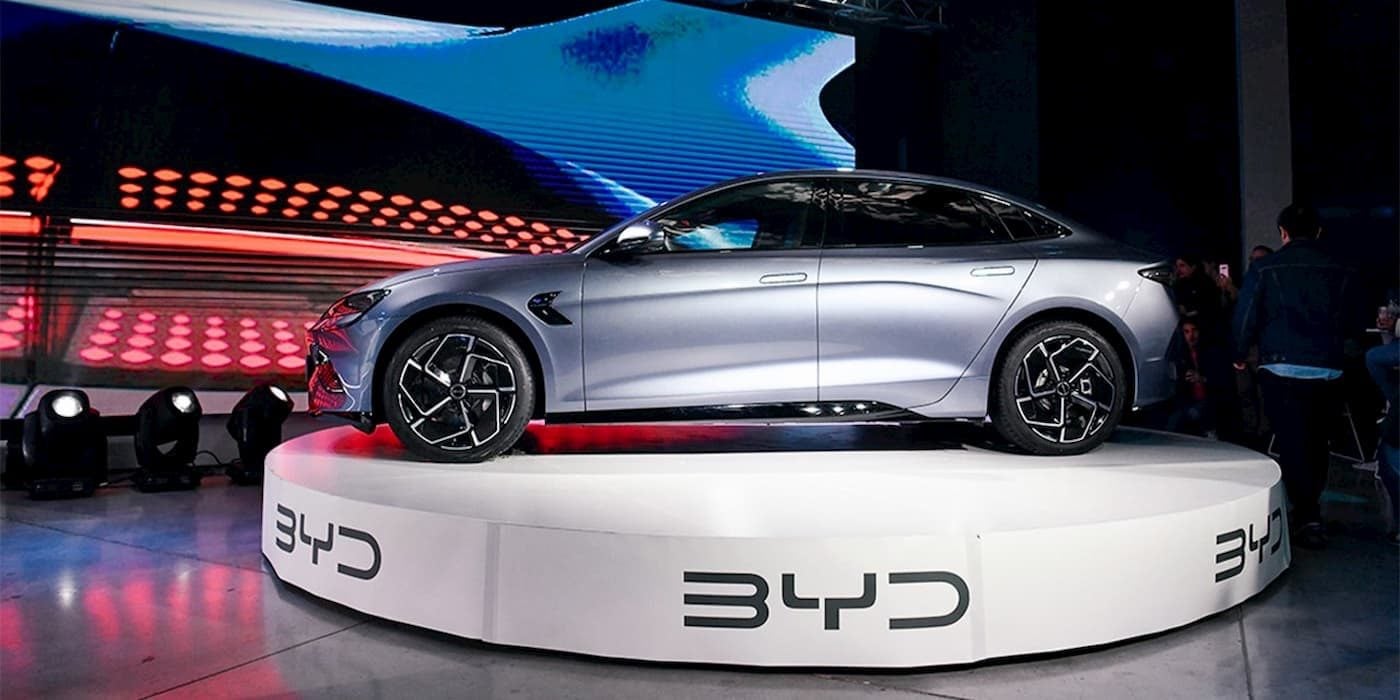
The Alliance for Automotive Innovation, which lobbies for GM, Toyota, Volkswagen and nearly every other major automaker, is pushing Congress to pass a permanent ban on Chinese vehicles when lawmakers come back next week, Reuters reported. I think that’s the wrong call, and I’d rather see imports allowed with the tariffs brought down.
The bill has momentum. It cleared a Senate committee in July and the House version has more than 100 co-sponsors, even though a Biden-era rule already keeps Chinese automakers out and their EVs face tariffs above 100%.
The data concern is fair, since cars know a lot about where we go. Washington can require any automaker selling here to keep American driver data in the US and open its software to inspection, and that would handle the risk without a permanent ban.
Then there’s who’s asking. Ford announced a $19.5 billion writedown last December as it scaled back its EV programs and GM booked $7.6 billion in EV charges in the back half of 2025, and both are Alliance members. Rivian and Tesla aren’t members, and RJ Scaringe has said the industry should plan on Chinese EVs arriving because “the technology is much better.”
Alliance CEO John Bozzella pointed to Europe, where the EU imported more than 1.1 million Chinese vehicles in the first eight months of 2026. European buyers get to shop BYD and Zeekr alongside VW and Renault, and BYD’s European sales jumped 80%to 178,000 in the first half of 2026.
A permanent ban would lock in today’s prices and today’s lineups for years, and that’s a bad deal for anyone shopping for an EV, including the folks waiting on R2. Competition is how this market gets cheaper and better.



Can’t agree with you on this one, Jose.
If you think we have too many concerns about privacy now, just wait if/when the CCP backed auto companies are allowed to be sold in the USA. FAIR Competition is good for the consumer. CCP backed autos should never be considered as fair competition. Who knows how many innovations the CCP stole from USA (or any other country) through espionage. There are plenty of EV choices made in the USA and other non-CCP nations and there are going to be many more in the next few years. VW in Europe could cease to exist if the Europeans keep allowing CCP backed auto to be sold in the EU.
China already knows where we go. Remember when there was a bipartisan push to ban tiktok before last election? Once the votes were in, nobody cared anymore. True capitalism breeds on competition. The US is behind on several aspects of education, technology, and infrastructure, because we decided to close our borders to enrich the EXISTING monopolies and not focus on the good of the consumer. Capitalism = great. Late-stage capitalism = 💩
Hey, we don’t have to agree of course, I’m always happy to see both sides and get an understanding of it 🙂
Let them. Rivian and Tesla will dominate EVs in the US while lackluster OEMs keep waiting and destroying the environment. Until we have actual regulations for emissions and incentives again, it’s a nonstarter.
I think it’s more about product dumping than privacy. How can US companies compete with Chinese cost of labor and heavy government subsidies? We can’t. Great article in the WSJ about the overstock of Chinese EVs right now, looking for a place to be dumped. Unless RJ and Elon start building cars with robots that don’t need health insurance, we can’t compete.
Agreed – China has reached it’s current growth limit in-country and since GROWTH is the primary political platform for Xi – they’re very aggressively pushing and subsidizing costs through their “winner take all” industrial expansion policies. While it might be fair to be concerned about privacy, this is also US protectionism.
Agree 100%. The government of China does not play fair with labor practices and they subsidize raw materials with the goal of putting the competition out of business. If we care about the American worker we need stiff tariffs on products coming from regions not treating their workers right.
Couldn’t agree with you more, Joe. You hit the proverbial nail on the head.
It would not be an equal playing field to allow China into the United States EV market. That’s just a fact. When China wants to start following the rules, we can enter into a discussion. Since that most likely will never happen, the point is moot.
This is the same Ford that has been visiting China and publicly praising their tech. FWIW.
Will Tesla and other companies slow then to use the charging network? If not, good luck to them.
“Competition is how this market gets cheaper and better.” — you nailed it, Jose.
Look, let’s take all of the data privacy issues and protectionism concerns as givens. Fine. So, tell me then, Big Three: what can you sell me that’s just as good or better than these banned vehicles? They’ve got nothing. The fact they don’t even sell a 3-row hybrid in today’s market is ludicrous. They don’t deserve protection if they make a terrible product.
Normally I am in favor of the free market playing out, but China does not treat their workers fair. If we value our workers we need stiff tariffs on goods coming out of regions with unfair labor practices.
Protectionism, such as tariffs or sales bans, reward mediocrity and raise prices. Companies have little incentive to innovate or improve their product if they are protected from competition. Ultimately, hurts the people whose jobs are supposedly being protected.
I think allowing Chinese manufacturers to produce vehicles in the U.S. with the same cost structures is something I’d be open to. But allowing Chinese EVs produced under China’s structural cost advantages would not be good for the U.S. but industry or arguably even the U.S. consumer given the downstream impacts. Although getting a cheaper car would be nice, the cost would be U.S. automotive companies and workers losing their jobs in staggering numbers due to this uneven (and arguably unethical) cost advantage. This would be a net negative in my book.