
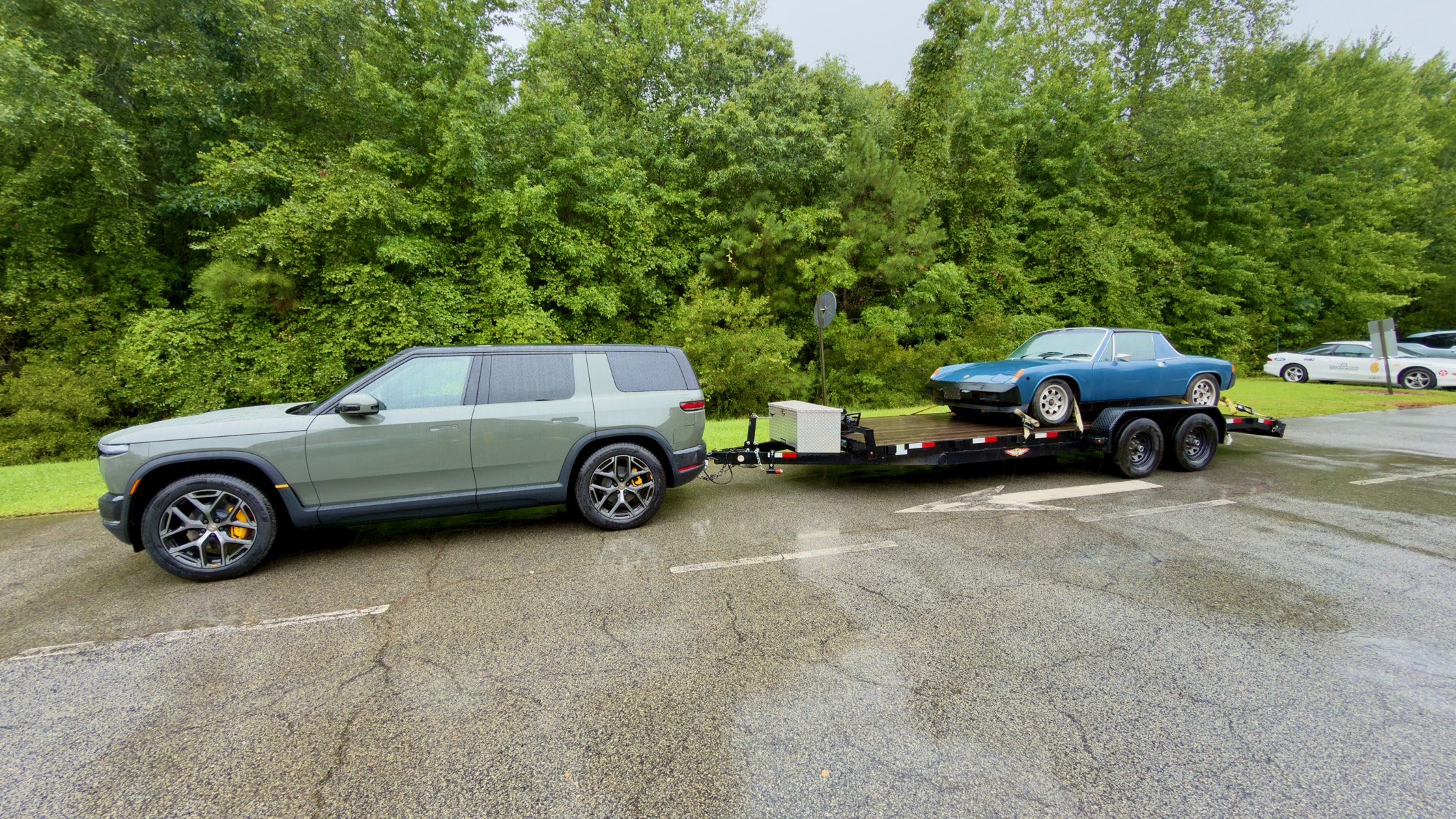
The R2 tows 4,400 pounds in dual-motor, all-wheel-drive form. I brought my Launch Green R2 Performance out to the track with Kyle and Alex from Out of Spec, and we ran it at exactly that number, with a rusted electric Porsche 914 strapped to a car hauler and about 450 pounds of tongue weight on the ball.
Short version, it tows better than the rating suggests. 4,400 pounds beats a Model Y at 3,500 and falls well short of a Macan at 5,500, and nothing about the way the R2 handled max weight made that number feel like a hard ceiling.
Which R2 trims can tow
The tow package costs $950, and it is all-wheel drive only.
The base R2 Standard with rear-wheel drive cannot get it. Neither can the rear-wheel drive Standard Long Range. Step up to the Standard all-wheel-drive Long Range, and the package becomes available, but the rating drops to 3,500 pounds.
Premium and Performance are both all-wheel drive, and both carry the full 4,400-pound rating.
Payload is tighter than the tow rating.
On the Performance we tested, the GVWR is 6,173 pounds, and the max payload is 1,168 pounds. Rear axle rating is 3,638 pounds, front is 2,866.
Rivian recommends tongue weight at roughly 10% of loaded trailer weight and does not publish a separate maximum anywhere we could find, so 440 to 450 pounds is the working number at max tow.
Subtract that from payload, and you have about 718 pounds left for people and cargo. Three adults and some gear gets you there. We were three grown men with a fully loaded trailer, which is to say we were sitting right at the edge of what Rivian says the vehicle can do.
If you tow at max weight, payload is the first limit you run into.
Hitch setup and what to expect
You get a 2-inch receiver behind a removable fascia panel under the rear bumper. Two quarter-turn clips release it, and the panel pulls rearward rather than straight down.
The seven-pin connector is rotated 90 degrees to the left relative to R1, so the tab faces the driver’s side.
You will want a riser rather than a drop hitch. The receiver sits low, which is normal for this class of vehicle, but the rear camera is mounted right down at ball height, so once you add a riser the hookup view gets awkward and you end up eyeballing the last few inches.
There is an integrated trailer brake controller, which is a real win on a vehicle this size. Gain adjusts on screen, and manual actuation lives on the haptic halo wheel.
Tow mode gives you three saved trailer profiles plus an accessory setting. Adaptive cruise and lane centering shut off while a trailer is connected, and Conserve and Sport gray out.
How it tows
Rear squat measured one inch, from 34 and 5/8 down to 33 and 5/8 at the fender, with about half an inch of rise up front.
There is no air suspension on R2, so it cannot level itself the way an R1 does. In Performance, your only tool is damper firmness, and it matters more than you might expect. Soft feels floaty over big bumps at speed. Firm settles the whole thing down.
Which leaves an open question about Premium, since it carries the same 4,400 rating without the semi-active dampers, and nobody has towed one yet.
Beyond that, the R2 does not feel strained at max weight.
A few behaviors worth knowing about: power is limited in tow mode, so wide open throttle holds something back, which is almost certainly deliberate and fine. Regen runs on the rear axle only. And trailer brakes do not blend with regen at all, so one-pedal driving will not bring them in, and you have to actually touch the brake pedal, same as R1, which is still the thing I would most want changed.
Range while towing
Around town, we saw 1.5-1.7 mi/kWh. At a steady 70 mph on the highway, it fell to roughly 0.8.
Some of that is just physics. A trailer behind an R1S or a Silverado EV sits partly in the shadow of a much larger vehicle. The R2 punches a smaller hole in the air, so more of the trailer is exposed, and the efficiency penalty lands harder in percentage terms.
Do not trust the on-screen estimate. With the trailer entered, the R2 showed 95 miles at 100%, while we were observing 1.7 mi/kWh, which should have worked out to closer to 150 miles. Rivian has been bad at towing range estimates for years.
The rear charge port is the other real-world issue. Pull-through stalls barely exist, so towing with a rear port means unhitching or blocking a lane at most stops. R1 having the port up front is a genuine advantage on a towing road trip.
So should you tow with an R2
For occasional towing, a track car on a hauler or a boat down to the lake on a weekend, yes. It handles it with more composure than I expected going in.
For heavy towing or any real distance, the pack size and the charging logistics are going to catch up with you, and a used R1 is the more sensible tool.
Still open: how Premium behaves without the adaptive dampers, and what the final Standard trim details end up looking like. I am also curious whether Rivian will tighten up rear-axle regen and trailer-brake blending in a software update.



Jose, what would you say for the occasional T@G trailer for a camping trip maybe 200 miles away? Obviously won’t do it in one charge, but you think it would handle it?
No issues whatsoever, I feel like that’s the type of trailer designed for this!
Given your experience using the hitch do you have any initial impressions on how using a hitch mounted bike rack or similar smaller hitch accessory would work? In particular any concerns?
I’d be curious what track cars and what trailers would work out with the R2. I was seriously thinking of a GT86/BRZ track car, R2 to tow it to the track.
Jose, is a riser actually necessary? In the video, it looks like they lowered the ball mount so it sits level with the hitch rather than using a rise. Am I seeing that correctly?
I’m considering an R2 to tow a travel trailer and can’t find any information about the receiver height (measured to the top of the receiver). Anyone have that number?
What’s the height to the center of the tow receiver?
or if you know.. what size riser/drop did you use and what was the coupler height on the trailer?
thanks you so much for this article