
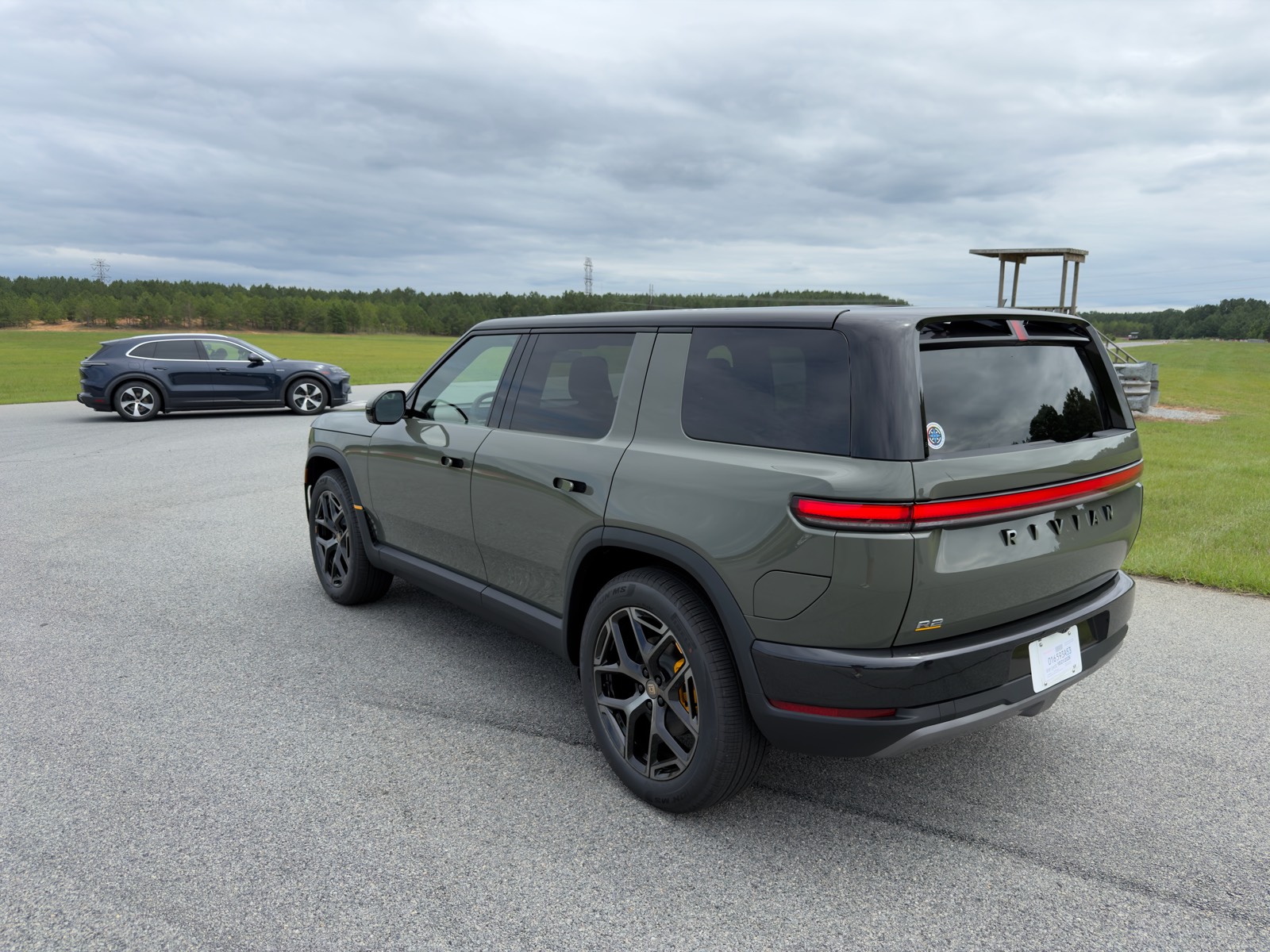
My R2 Performance spent last week getting benchmarked by the Out of Spec team, and the charging is the part I want to get into. Short version: it charges way better than a 400-volt car should be able to.
The first real test was the 10% challenge, run at an Ionna station up in Wilson, North Carolina. Those Hyper 400 stalls do 600 amps, which is basically the most current you can pull from a public charger in the US right now. Plugged in at 10%, the R2 walked itself right up to 600 amps and just sat there, flat, all the way to around 32% before it started backing off.
Peak was around 229 kW on a 400-volt pack. Rivian didn’t chase high voltage the way Porsche or Lucid did. They went the high-current way instead.
Here is the part that got me. The R2 wanted more than the charger could give it. During the handshake, it asked for 650 amps, but the Alpitronic HYC400 cap is at 600 amps. So we’re not even seeing the top of this pack, because there is no public charger in the US yet that can hand it everything it is asking for. One thing worth being upfront about though, even once we do get it the full 650 amps, I’m not expecting a huge change in charging times. It’s more headroom at the very top of the curve than a whole new curve, so realistically we are talking a few minutes, not night and day.
At 50% it was still doing something like 165 kW. A Model Y Performance, which Kyle from Out of Spec had run two days earlier (same test), was down around 92 to 94 kW at that same 50%, but it does have a smaller battery. Batteries are close in size, the R2 holding 87.9 kWh usable. The curves are not close at all.
That 15-minute stop averaged 193 kW. It added a little over 48 kWh and took the pack from 10% to basically 60. Zero to 90 came in under half an hour. Battery temps crept into the 120s, and nothing got weird, though that was mild weather, 70 to 80 out, and I still want to see this thing stress-tested in real Florida heat before I call the thermals solid. Sitting on 600 amps that long, at that state of charge, this might be the best charging 400-volt car on the market right now.
Now the part Rivian is not going to put on a slide. The charging is doing a lot of the heavy lifting.
Efficiency at 80 mph came back at 2.2 mi/kWh on the stock 21” all-season tires. That Model Y Performance did 3.29 mi/kWh in the same kind of run, with only about a 10-degree temperature edge on it. RJ has said out loud that the R2 matches Model Y efficiency. At 80, on this test, it did not, and I am not going to pretend otherwise just because I’m a Rivian fan and owner.
But a road trip is charging and efficiency together, and the R2 covers a soft efficiency number with a really strong charge. The Model Y does the opposite. It sips energy and then charges slowly. I have always liked the first kind of car more. The day it gets cold, or you throw a trailer on the back, all that Tesla efficiency goes away, and you are stuck at a slow plug. The R2 keeps its charging no matter what the weather is doing.
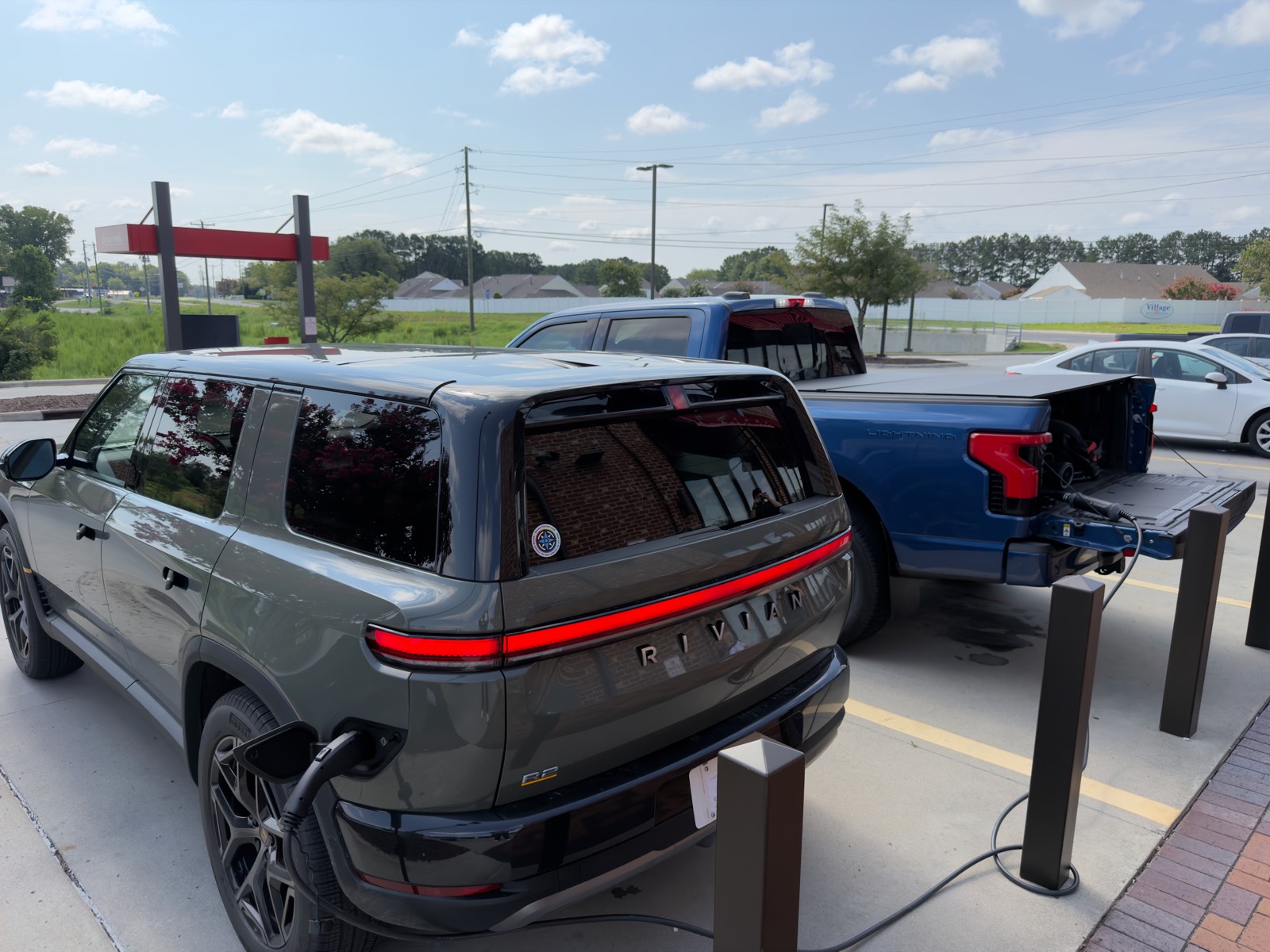
It is also a better road tripper than the R1, which is the comparison plenty of current owners actually care about.
The reality is that the R2 is being held back by the chargers. As the Rivian Adventure Network and IONNA put in stalls that go past 600 amps, this exact car, the one sitting in my driveway right now, will charge slightly faster.
The Out of Spec crew is putting together the full charging charts and their deeper analysis, and that should be up on their channels by the end of the week. I’ll share it here the second I have it.
So no, it is not a Taycan or a Lucid when the miles get long, and it was never trying to be. But for a 400-volt pack, on the chargers we actually have today, it did something I did not really see coming. And we still have not found the top of it.



Hello Jose. A huge thank you for sharing your R2 w/Kyle and OOS. As you said, the charging test was a surprise: the efficiency test was a disappointment after the EPA numbers came out. Turns out that, no, Rivian does not have the magical powers necessary to overcome the laws of physics. What they achieved with a big, beautiful box is pretty amazing though. At the end of the day, I’m confident most R2 buyers aren’t doing so because of efficiency. I’m looking forward to your Pet Mode testing.
I noticed in the article you never mentioned if you were charging using native NACS or using a CCS to NACS adapter for these results.
Native NACS, no adapter
That’s great news! That’s what I like to hear. 🙂
Tesla made a car that went from 0-90% in 27 minutes. It went from 10-80% in around 17 minutes. This was the Gen 1 Model Y in europe with BYD batteries.
The C-rate was more than 2 which is double what a usual tesla charges
Tesla is conservative with charging rates and clearly you can have high charging speeds over 400v if you have good batteries.
I just charged my R1T at a Tesla level 4 charger at 214 kw for about 15 mins. Got hot and slowed to about 175 for another 15 mins. So, not much different. It was kinda warm out, about 87 degrees.
Have you heard anything from Rivian on if that level of efficiency is expected? I just road tripped our R1S Tri fully loaded 7 hours at 77mph. Was averaging right around 2.15 miles/kwh almost the entire drive. Obviously not apples to apples with your drive but there is no reason an R2 should be anywhere close to an R1S tri given it’s 2000 pounds lighter and more aerodynamic
In the article, you said that the R2 is a better road tripper than the R1. Is there an article that discusses that?
Coming soon!
Thank you for all that you have done with the R2 and OOS team. I think it would be nice to update this article with the exact time from 10-80%, as that is (in my opinion) the best benchmark that is being used across many OEMs.
Please do a road trip comparison between the R2, R1 max gen 2 and the older R1! Us OG R1 owners want to know if we should upgrade!
Thanks for all the info. What home charger are you currently recommending. New to EVs! Leaning towards tesla universal?
The Tesla is a strong choice, but I think EVIQO is a better value. Despite the name, it’s not a Chinese no-name brand, but a US company that seems to be about no-nonsense, high quality engineering.
See this list for more choices:
https://evchargingstations.com/best-home-ev-chargers-of-2025/
Thank you for this Jose.
I do have a question. In the article you said, “…it asked for 650 amps, but the Alpitronic HYC400 cap is at 600 amps….there is no public charger in the US yet that can hand it everything it is asking for…”
From what I understand, the newest RAD chargers can provide 650A. I mean, it stands to reason Rivian would make and deploy chargers that can support the R2.
But I am not questioning your accuracy. Only my understanding. Is there some reason these Rivian chargers can not support the R2’s charging request? (I mean the answer could be “because there are none of those chargers deployed yet.” Or something more technical about the electrical specs.)
I suspect it matters little. As you said, it would probably not do much for the charging time.
RAN will be able to accept 650 amps but not yet as my latest understanding
My 2018 Tesla Model 3 can charge at 250 kW for about five seconds. Its peak charge performance is awesome, but the curve is trash.
Which is to say that Tesla Superchargers can clearly give the R2 everything it could want from an amperage perspective. I’m given to understand that they won’t, as a matter of policy, do so for non-Tesla cars. Is there any indication that this may change in the future for the R2 specifically?