
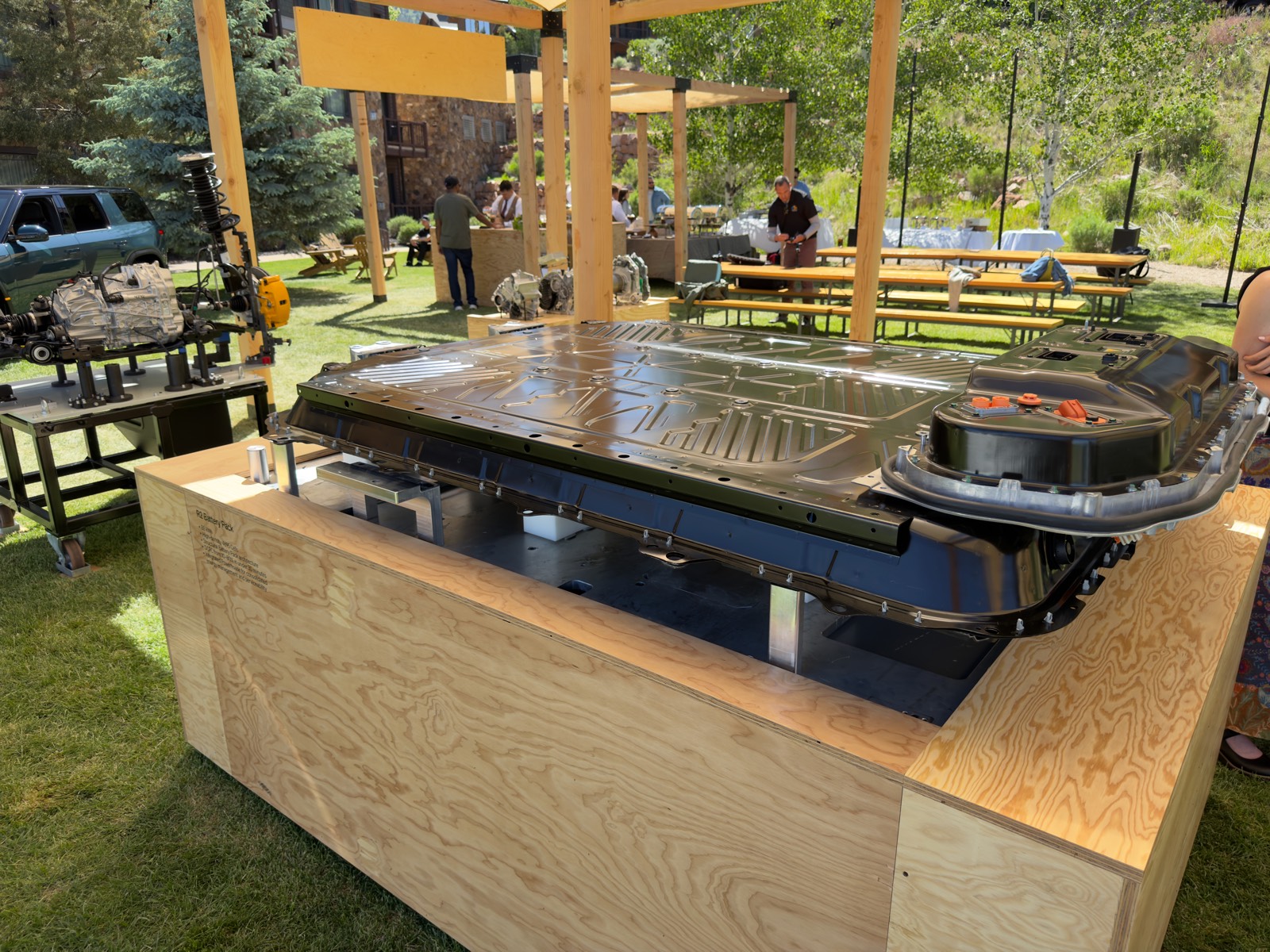
A lot of the R2’s cost savings came out of the battery pack, and Rivian managed most of it without cutting anything owners would actually notice. The engineering team explained how during a Munro Live teardown at their Engineering Prototyping Development Center in Plymouth, Michigan, where a good bit of the savings traces back to the larger 4695 cell and the structural pack built around it.
The R2 pack uses 776 of the new 4695 cells. That is a lot fewer than the R1, which runs 7,776 of the smaller 2170 cells, and the move to a much larger cell is why the count drops so far. Matt Wolfe, who leads hardware engineering for the R2, and Greg Dachner, the program director and chief engineer, joked that the door flashlight brings the R1 up to 7,777.
The new cell is taller, so Rivian had to find space for the extra height. They didn’t want it to raise the floor where your feet go or where the seats attach, so they made the vehicle floor part of the battery pack. This removed an extra layer of structure and saved about 7mm.
Much of the space they saved was used for venting. The bigger cell now has a few more millimeters for venting, which allowed the team to simplify the system and use fewer pressure release valves. This small detail helps Rivian lower the battery pack’s cost.
The battery cells are placed below the floor, and the entire pack is structural. This means the battery is more than just a protected box, and it helps absorb crash forces and makes the vehicle stiffer. The cells are fixed in place, and Rivian designed the pack so it never needs to be opened for cell-level repairs. Most serviceable parts, like the power electronics, are in a separate unit under the rear seat.
There’s more to explore from the Munro teardown, especially about the structural pack and the front suspension.



“Surprisingly, both battery packs use the same number of cells. The R2 has 7,776 of the new 4695 cells, while the R1 has 7,776 of the smaller 2170 cells. Matt Wolfe, who leads hardware engineering for the R2, and Greg Dachner, the program director and chief engineer, joked that the door flashlight brings its total to 7,777.”
Jose, I watched the same video, and he said that there are 776 of the 4695 cells, not 7,776 (skip to 1:50 mark). The 4695 batteries are much taller and wider than 2170, so there’s no way that they could fit the same number of cells in a smaller vehicle.
R1 has 7,776 cells in it and the flashlight was famously invented partially to get it to a straight 7,777. R2 has larger and therefore less cells at 776 with the 777th being the door flashlight once again.
Except the flashlight uses a normal 18650 battery so it shouldn’t be counted with the R1’s 7776 2170s. If you are counting accessories, then you also need to count the cells in the camp speaker.
Let’s not be pedantic, else we would start counting the key fob and the 12v batteries.
Again, great info and love the 7,777 design fun. Shows early Rivian engineer playfulness that spill joy into the R2. Can’t wait to see what the R3/x easter eggs look like.
The R2 pack uses 768 cells, not 776 as stated in the article.