
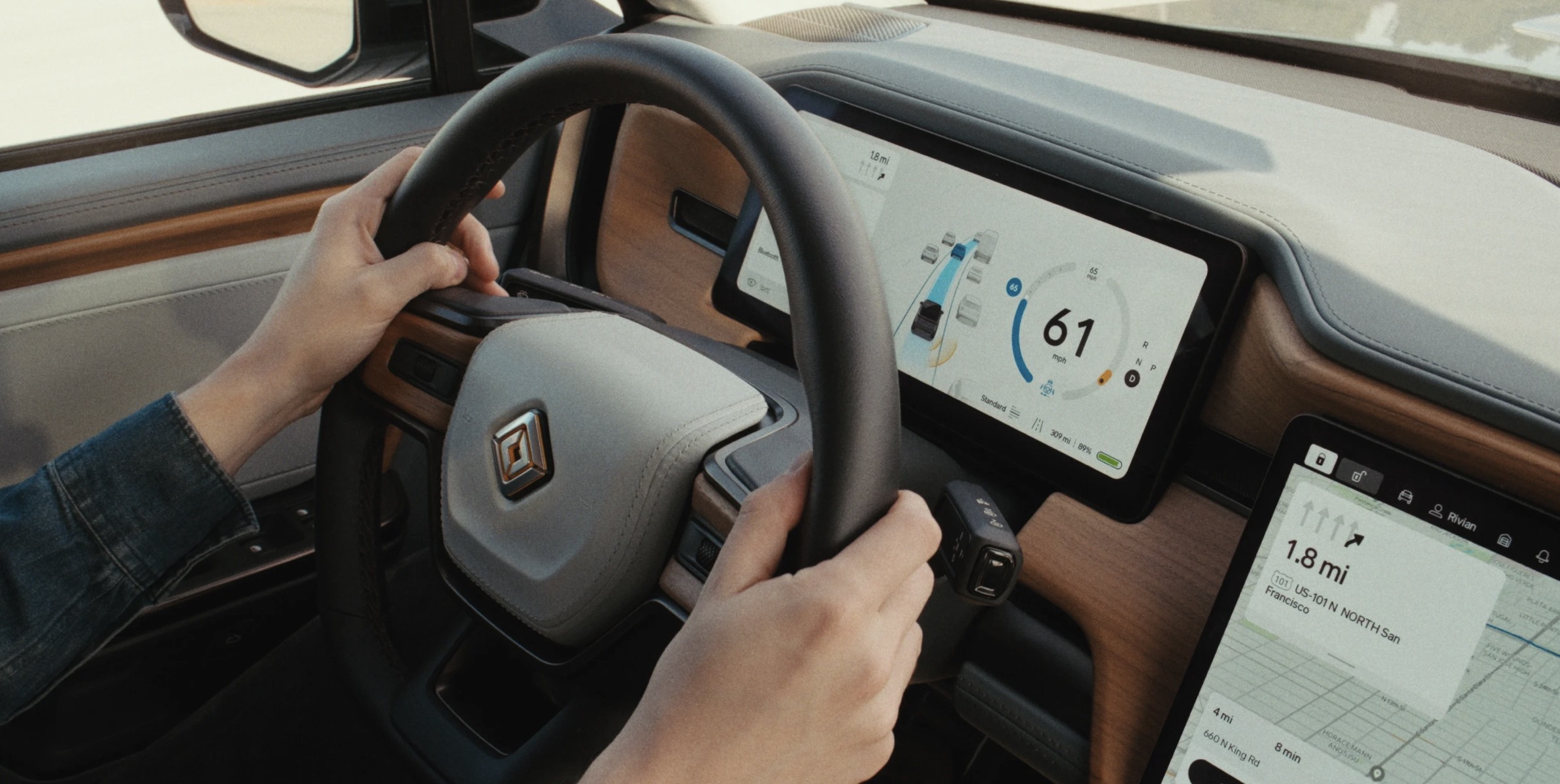
Rivian’s “AI-defined vehicle” framing sounded like marketing theater when Chief Software Officer Wassym Bensaid first dropped it on stage at Autonomy and AI Day back in December. Five months later, with Rivian Assistant actually shipping and a wider AI strategy coming into focus, it’s a lot harder to write off.
The basic pitch is that the software-defined vehicle era was the warm up. The next phase is a car that gets smarter the longer you own it, learning your patterns and adapting over time. That sounds like the kind of thing every automaker is saying in 2026, but Rivian is one of the very few that has the vertical stack to actually try it.
The most obvious public proof is Rivian Assistant, which rolled out in 2026.15 last week. It isn’t just a voice command layer wrapped around the existing UI. It has direct access to the vehicle’s electronic architecture, so it can handle drive modes, ride height, climate, navigation, and Owner’s Guide lookups in a way that feels native to the car. Tesla’s “Hey Grok” voice assistant launched in their Spring 2026 update and on paper it sounds similar, but in practice Grok still can’t control climate, media, or any of the car’s core functions months later. The optional Memory feature learns your preferences over time, and Google Calendar integration ties driving context to your schedule, with Apple and Outlook on the roadmap.
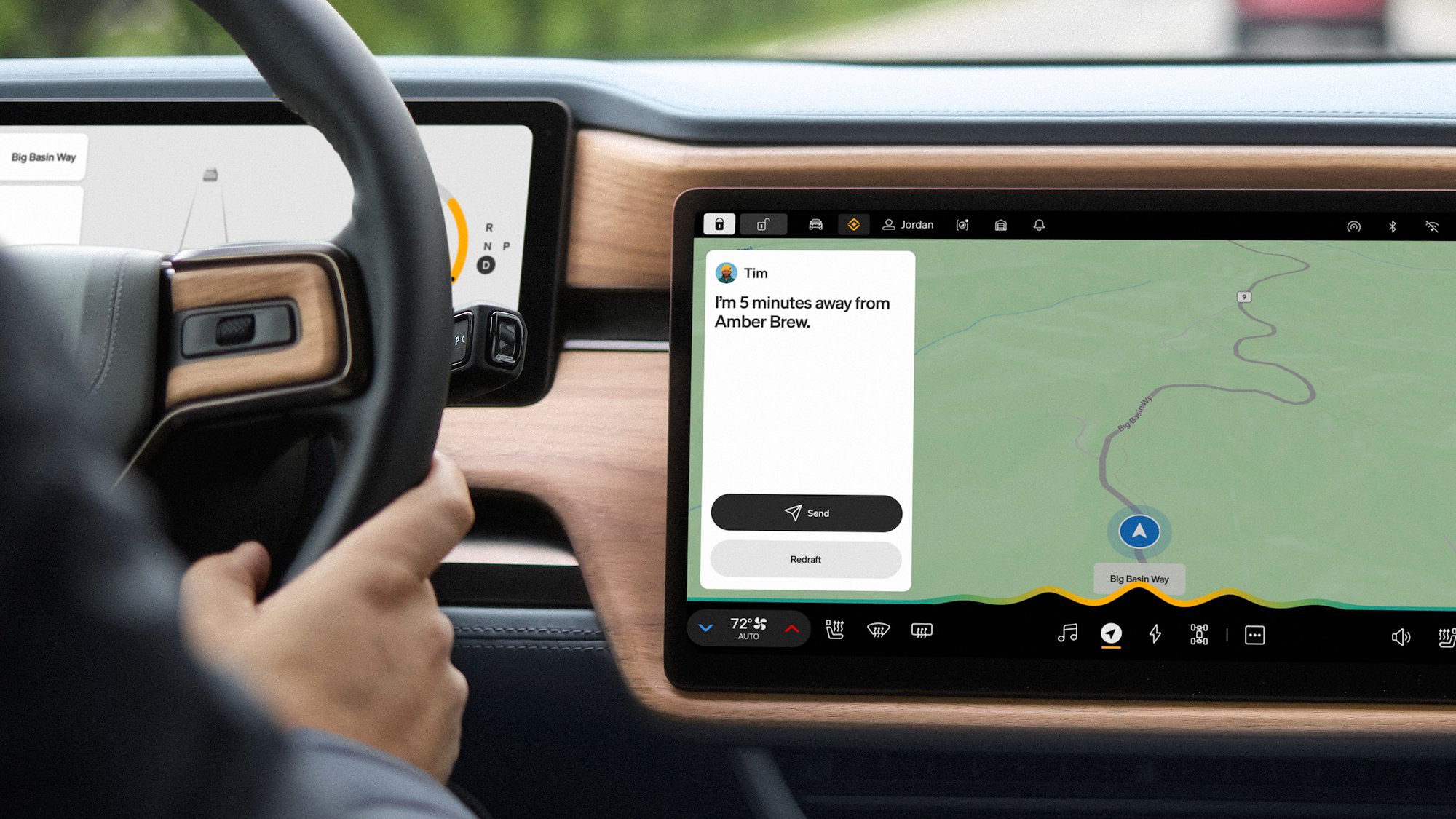
Behind the assistant sits something Rivian calls Rivian Unified Intelligence, a multimodal AI platform the company says is interwoven throughout the business. Above that there’s the Large Driving Model for autonomy, the Autonomy+ subscription that’s supposed to keep expanding, and the in-house Rivian Autonomy Processor arriving later this year with 205 GB/s of memory bandwidth that Senior VP of Electrical Hardware Vidya Rajagopalan described as key for AI applications. The R2 will eventually get all of it, and that’s where this story really has to land, because R2 is the volume vehicle.
Then there’s everything happening outside the cars. RV Tech, the Volkswagen joint venture, just hired Manasi Vartak as VP of AI and Data, and she’s been openly framing this as an iPhone moment for cars where vehicles without AI won’t exist in five to ten years. Mind Robotics, the industrial robotics company RJ Scaringe founded last year, just crossed a billion dollars in total funding and is using the Normal plant as its live training environment. The AI bet isn’t just about a smarter R1 or R2, it’s a company wide direction that touches voice control, autonomy, manufacturing, and the joint venture partners learning from the same playbook.
Of course, all of this only matters if the follow through is there. AI assistants get hyped and then quietly fade into the same mediocre voice control we’ve been ignoring for years. The Memory feature has to actually feel useful when you’ve lived with it for a while, not just demo well in a first session. The Autonomy+ roadmap has to keep delivering instead of stalling out the way some of these subscriptions tend to.
The structural advantage Rivian has is what makes this interesting though. Most automakers calling themselves AI companies right now are stitching third party models onto infotainment stacks they don’t fully own. Rivian controls the architecture and the chip roadmap and the software layer and the OTA pipeline and now the AI platform sitting on top of all of it. That’s a real starting position. Whether they actually run with it or quietly let the lead slip is the question worth watching for the rest of 2026.



Another great article, Jose! Can’t agree with you more.
It’ll be interesting to try the new stuff when my Rivian gets the update. It was scheduled to install at 2am a few days ago, then didn’t. No idea when or if it’ll update.
Jose – can you go into deeper detail with your thoughts regarding Rivian’s AI play and what it’s limitations will be in non-RAP Rivian’s, including the launch editions of R2?
Absolutely I have something in the works!
Awesome! Looking forward to it.
“… is a lot harder to write off.”
Why are we trying to write it off? If we are, explain. If we aren’t why say it?