
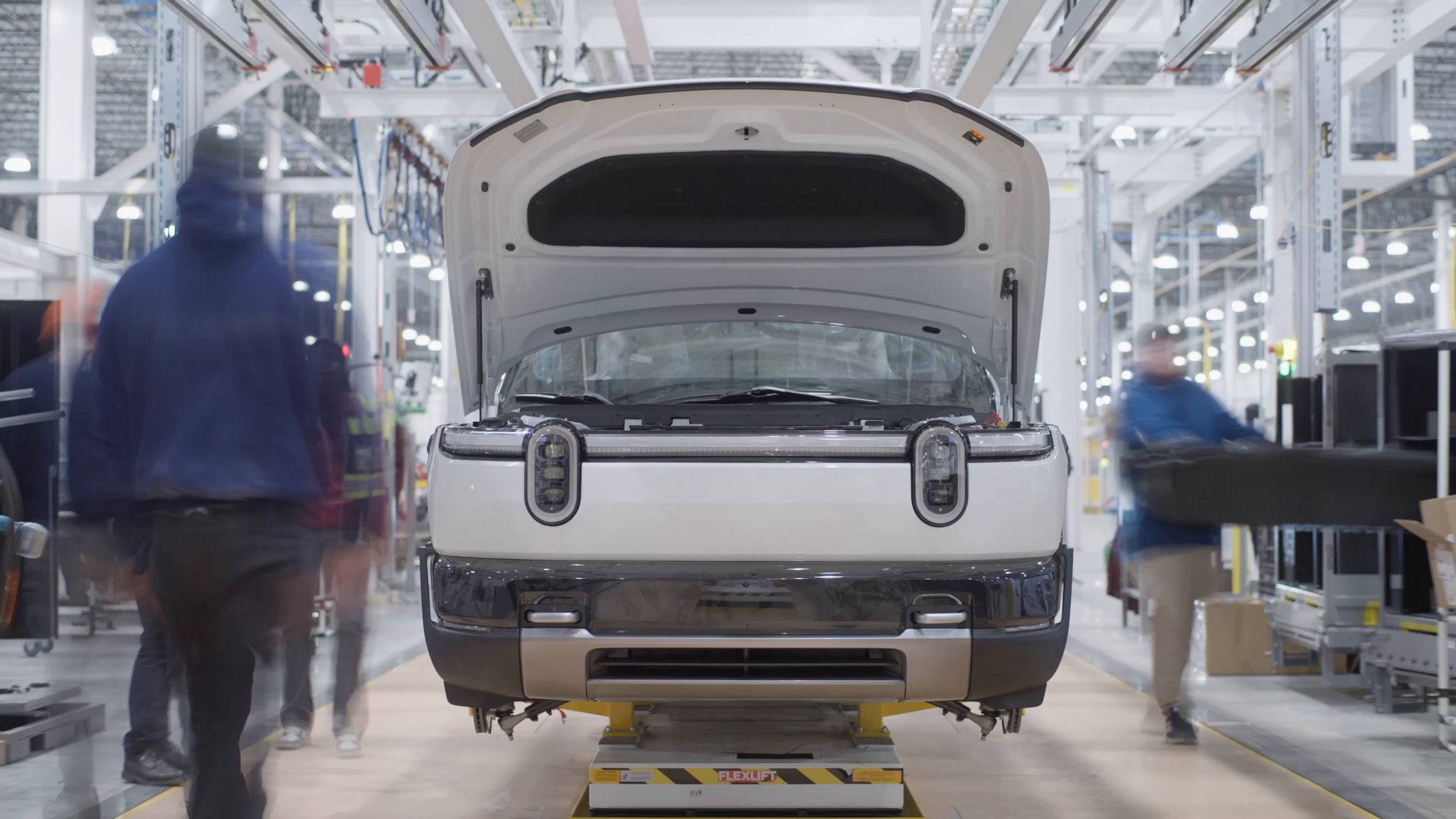
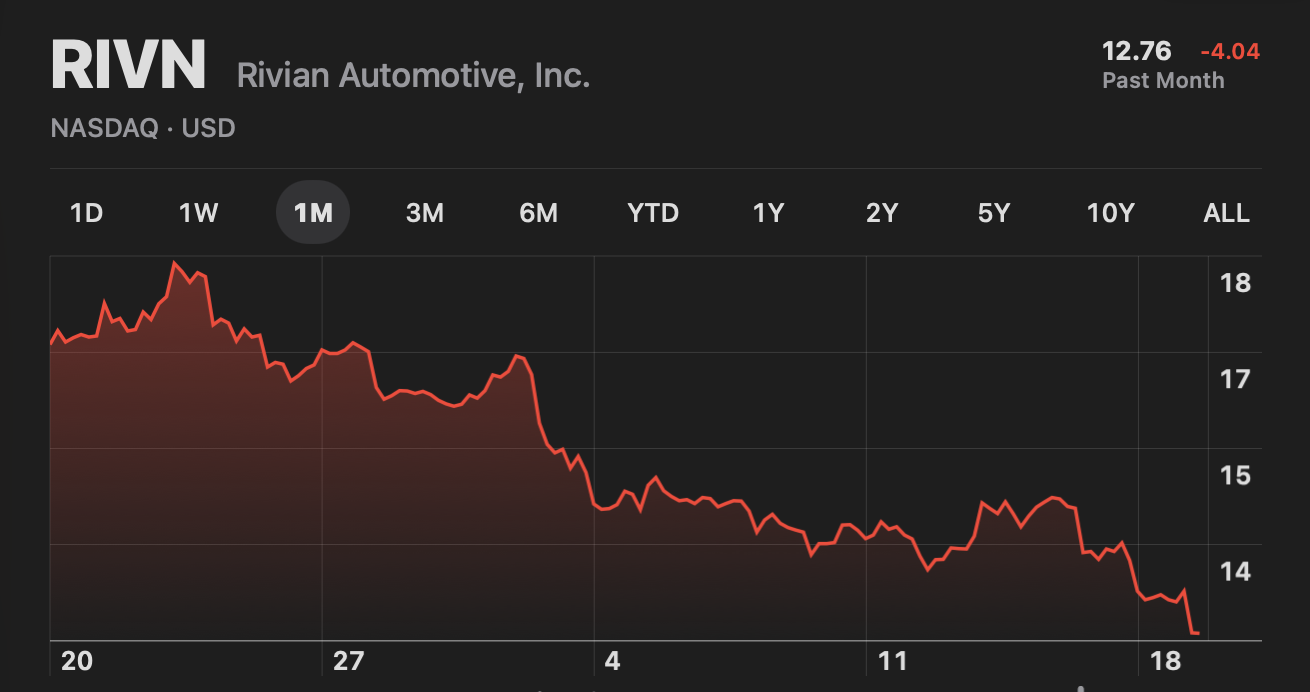
There is a real disconnect happening at Rivian right now. The company just started producing the R2 at Normal, beat Q1 earnings estimates, locked in another $300 million from Volkswagen at a 15.9% stake, and delivered 20% more vehicles than the same quarter last year. RIVN closed yesterday at $13.30, down roughly 31 percent on the year, sitting closer to its 52 week low of $11.57 than its 52 week high of $22.69.
That is not a small gap. That is the market and the operational reality reading two completely different stories.
The R2 milestone alone should have been a moment. Rivian rolled the first saleable R2 units off the line at Normal on April 22, just days after an EF-1 tornado tore through Building 2. Recovering in under a week and still hitting the production target was, by any honest measure, real execution. The Performance Launch Edition at $57,990 is not the mass market vehicle the long term thesis depends on, but the line is running and external customer deliveries are happening this spring (or so they keep telling us).
The Q1 numbers were genuinely solid. Revenue came in at $1.38 billion, up 11% year over year and just ahead of Wall Street estimates. Deliveries hit 10,365. Gross profit was positive for the third quarter in a row at $119 million. Software and services revenue jumped 49%. The reported loss of $0.33 per share was nearly half what analysts were modeling. Most companies would have traded up on a quarter like that. RIVN slipped instead.
Volkswagen also raised its stake to 15.9% in early May through a $300 million private placement, a move that says more about long term confidence than any analyst note. Georgia plant capacity was raised to 300,000 vehicles a year by late 2028. The $4.5 billion DOE loan continues to move forward. None of this looks like a company unraveling.
So why is the stock not reflecting any of it. The honest answer is that the market is looking past everything Rivian is doing right and focusing on what is still missing. The federal EV tax credit is gone, which has dragged demand across the entire segment. Free cash flow was still negative $1.08 billion in Q1. Long term debt is sitting above $5 billion. The cheapest R2, the one that actually unlocks the volume thesis, is not coming until late 2027. Add tariff overhang and broader EV sentiment and you get a stock that cannot catch a bid even on good news.
That tension is the whole story right now. Analyst targets average around $18.85, with Benchmark at $25 and Cantor recently raising to $19. The numbers suggest that Wall Street still sees value here.
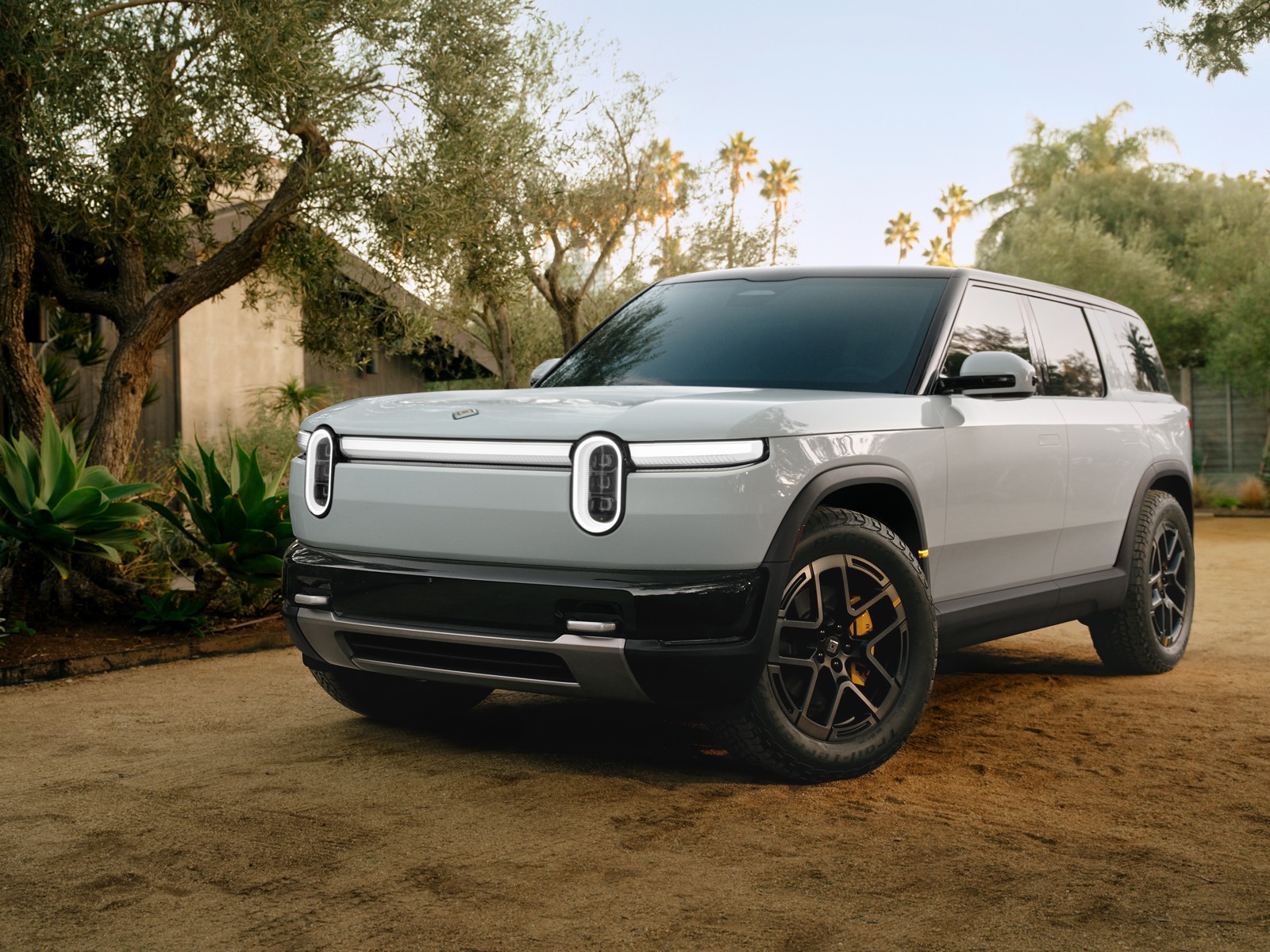
As an owner this stretch has felt like one of the strongest the company has put together. The vehicles are better than they were six months ago. The R2 is real. The product side is firing. Whatever the market is pricing in, it is pricing in skepticism about the next 18 months of execution and not skepticism about whether Rivian can build a vehicle people want.
What happens next probably comes down to R2 delivery cadence through summer and fall. If Rivian can show consistent weekly numbers ramping into Q3 and Q4, the gap between the stock and the underlying business starts to close. If the ramp stutters, patience thins out fast. The market is not going to get convinced by another good earnings report alone. It wants R2s leaving the factory in volume, gross margin holding up, and cash burn trending in the right direction. None of that is impossible from where Rivian sits today. It just has to keep delivering through one of the rougher stretches the EV market has had in years.



Jose, you didn’t mention that the VW investment is diluting the shares (new shares were doled out) and thus share price.
That’s because it isn’t an issue. The positives of the VW deal hitting another milestone and the evidence that VW still believes in and stands behind Rivian far outweigh the dilution which is common for a company like Rivian in this stage of growth. Also, this deal with VW and how it is structured has been known for a very long time now. It wasn’t (or shouldn’t) have been a surprise to anyone. Even the non pro average investor knows that dilution is not always a bad thing and certainly isn’t in this case.
Dilution isn’t an issue? In what world do you live in? In my world, two rounds of dilution or subsequent fundraising signals “short” to anyone who understands how to short stocks and has the resources. In case you aren’t tracking the macro economic picture Rivian is facing companies such as Lucid which is funded by the Saudi Public Investment Fund (PIF)! If the leadership doesn’t stop with spin off companies, alternate fund raising events, insider sell offs and focus on the basics then they will run the risk of predatory companies/ investors.
Two rounds of dilution because they gain investment doesn’t make sense, certainly not short. The irony of then using Lucid as an example – which has no real pain trigger to get to profitability, because the PIF won’t want to downgrade their investment and admit their pivot to different revenue streams than oil has failed – is hilarious. I’m not delighted about where Rivian is sitting overall, but that is mostly the nature of such a cash heavy industry and the phase (and it is a phase) of the EV market their in, not because they’re not delivering.
One thing I forgot…the growth isn’t being funded by profits, it’s from a DOE government loan similar to the GM bailout loan. The profits are being eaten up by high taxes in CA and Illinois, insider selloffs ( both planned and unplanned I.e. the issuance of 4 million shares of stock in a divorce) and that’s just naming a few. In summary DILUTION IS TERRIBLE FOR A GROWING COMPANY AND INVESTORS.
Full disclosure I HAD 2224 shares of Rivian purchased at $23.42 per share and I am no longer a shareholder. There is far too much insider selling happening at too large of a scale to present confidence in this stock, the existing tax burden at offices located within California and Illinois will continue to hamper CAPEX, the 2025 compensation package to RJ Scaringe was ridiculous considering shareholders are being priced out of profits and lastly but certainly not the least is that CAPEX for growth is a massive assumption of risk by shareholders while management has continued to further dilute shareholders by peak selling in order to cover INDIVIDUAL tax liabilities in both California and Illinois. I sold at a significant loss because I do not believe that fiduciary responsibilities are being upheld by leadership…even if profits are made, they will be reinvested for “growth” amidst significant insider selling.
I wasn’t bearish until I saw RJ’s 2025 compensation package. Everything else was acceptable up to that point. I had faith that the VW group would teach cost cutting efficiencies (Maximus drive units, zone architecture , RAP, simplified manufacturing by unibody construction versus body on frame, no air suspension etc…)tap existing supply chains, that the software stack would bring profits from Rivian platforms, VW platforms, International platforms, the partnership with Uber and Amazon would result in massive profitability. MY PROBLEM IS WHAT THEY ARE DOING WITH THE PROFITS! They certainly aren’t going to shareholders! They certainly aren’t being used for growth because they tapped a DOE loan (negotiated down to 4.5 billion) for expansion. They are simply diluting existing shareholders by issuing of stock, insider selloffs and a compensation package rivaling Elon Musk himself. Believe me when I say that I sat long and hard over my decision to sell..,at a significant loss. But that is business.
You realize RJ isn’t getting a single penny with that compensation package until the stock reaches $40/share consistently right? And that’s only step 1. He won’t get the full package until it reaches $140/share. So you’ll 3x your stock before RJ gets a single penny, and you’ll 10x your stock before RJ gets the full package.
You realize that means he will get $2 billion even if the shareholders have a negative 50% seven year return? He will get $4 billion if he delivers to shareholders less than the could have gotten if the put money in a regular FDIC insured savings account?
I hate to burst your bubble George but RJ Scaringe was paid $1.25 million in 2025 as a salary and his SEC disclosures in April 2026 alone double that. You should really look up his SEC filings before you dig your hole further. While you’re at it, Claire McDonough (CFO) is another one I recommend looking at. Have a blast and happy investing.
https://www.sec.gov/edgar/browse/?CIK=0001891517
I’ll help you out George. These are the SEC filings and I hadn’t given it much attention considering it is a startup. Open the link and look up all form 144’s which classify sale of common stock only. BLUF, RJ Scaringe is more than likely already a billionaire can walk away clean if Rivian goes bankrupt because he filed all sales correctly.
Probably some here who are more knowledgeable than I am about all of these financial indicators, however I will continue to buy and hold on for better results in the future. I know people that bought Tesla shares and sold at the slightest downturn but missed the rise completely around the time of their last stock split. I like Rivian more as a company than I do how Tesla is run. Maybe I’m approaching as a total beginner, but that is fine, I’m staying on for the ride.
I admire the courage John. I wish you the best but would like to offer some polite advice to clear my conscience.
1. Two rounds of stock dilution/ fund raising sends distress signals to the seeking to short the stock. Startups rarely survive if that happens and the only thing saving Rivian from this scenario right now is Amazon and Vanguard. VW is in a little trouble themselves right now and cannot bail them out.
2. Insider selloffs signal leadership hedges themselves personally at shareholder expense. Many startups structure these selloffs as a standard event claiming it as salary compensation for living expenses, but Rivian executives are also drawing salaries (RJ drew 1.5 million in 2025 and a significant stock compensation.)
3. Research “signal versus noise” for investors and EBITDA and you will better understand the financial trouble Rivian has been placed in by creating so many skews, operating in a heavily regulated and taxed environment and finally (worst of all) not emphasizing fiduciary responsibility. It’s all fun and games with someone else’s money.
Once again, best of luck. 😀
Don’t confuse loving a product with loving the value of owning the company.
I love Rivian – it’s just not a great investment right now.
“Don’t confuse loving a product with loving the value of owning the company.” -> I fully agree with this statement :-).
Now is exactly the time it is a great investment. Rivian is clearly oversold right now. There are countless examples that show what happens next. By the time good news regarding the R2 comes out the stock price will be in the mid $20s. Right now it is like Tesla in 2019 right before they had their first successful model, when they were priced right around $14 but within a year were well over $100.
Its pathetic company with no proper vision. It will never reach back $100 again. Forget $100, It wont cross $30 again. I would be happy if they move their Normal IL plant to Atlanta. Or simply go bankrupt.
Wow, comments jumping from bots & racist troll accounts. I guess “any engagement is good engagement” (you are monetizing this site, I hope?), just wish people wouldn’t come here and lie. These same trolls have been saying “Rivian is bankrupt, blah blah” on Facebook and other social media sites for years (probably a lot of them are short-sellers or paid by competitors). Meanwhile, Rivian just keeps on producing cars and working towards profitability.
Regardless, stock goes up, buy. Stock goes down, buy more. A lot of people have been making money the past few years buying the dip and selling the peak.
You can tell from the comments who’s never driven a Rivian (nor likely ever even sat in one). Best vehicle I’ve ever owned in 40 years of driving and working as a mechanic. The company has a great vision and plan despite what is, unfortunately, an extremely challenging economy right now. They need to move aggressively to get more “butts in seats”, as the saying goes. And hopefully after 2028, things will start to turn around.
Thanks for calling it out, I deleted RJ’s Ghost comments for this exact reason.
I’m speculating, but I think the dip is tied to the oil shock.
First, higher oil prices raise the risk of a recession, which would hit demand across the board, including R2.
Second, oil-driven inflation increases the risk of higher interest rates, adding pressure to Rivian’s already heavy debt load.
Third, we’re likely to see new EV taxes or fees to offset declining fuel-tax revenue.
One important risk that doesn’t get much attention is geopolitics. The probability is still low, but it’s no longer zero that the administration could open the U.S. market to Chinese EVs in exchange for support in the Iran conflict. If that happens, the impact would be severe for all U.S. EV manufacturers.
Rivian is not another Tesla, but it has potential. High risk, high reward…. but do not expect to get rich soon. Still a long way to go.
Just take a look at the comments to see why the stock has dipped against good news. There was enough short interest and enough volatility in a stock like Rivian that hit pieces and disinfo worked. The stock was either going to go up or down a significant amount after the latest call. If you look, you will find a number of articles that came out just before and after that call.
Looking at the comments you can see people believed many of those hit pieces. The most obvious is the whole pay package for RJ Scarenge. He doesn’t make any of it unless the stock hit’s insane benchmarks like $140/share but regular investors only saw the headline and either got angry or panicked, which it was designed to do. Or the dilution from VW. It was framed as a bad thing or new news when the deal had always been structured that way and it is an overwhelmingly positive thing that Rivian passed the winter testing and received the next $1 billion tranche. Companies often do deals like this and it is seen as a positive catalyst (becauase it is in this case) but, again, the articles released did their job. Another example of the price of the launch edition R2. Rivian has a ton of support for that variant and will be slammed building it for the next number of months but that wasn’t how it was framed. Of course they will sale a more expensive launch edition first.
Aside from the obvious hit pieces, the EV market in general has cooled (and again I must point out that articles written recently paint it as being dead or dying when that isn’t the case). There are a ton of used options which are being absorbed at a healthy pace right now. But, still, the EV market has cooled and is not currently growing in the US. The economy isn’t the greatest. Rivian has been too slow up to this point. However, even with all that, the stock should have popped after the call and didn’t. There is simply too much volatility and too many actors betting against it right now. But, with the R2, their plans for lidar, AI, autonomy and RAP1 chip, new industry clients outside of VW etc etc, Rivian is a strong buy right now. That is just my opinion, but it is over sold. Once the R2 shows big numbers it will be impossible to ignore and then it will be one positive after another all the way through the Georgia plant and the R3/R3X.
I try so hard to call out those hit pieces but of course I’m small in comparison. I just want to tell the truth.
Jose. How about setting up a poll at one of the prediction markets and the write an article about it? Would be fun to see what people assume Rivian stock will be at the end of the year
What Rivian has going for it is an excellent product and a founder/CEO who is a designer at heart. Much like Brian Chesky and Steve Jobs, RJ has an eye for detail, innovation, quality and consistency. If the R2 lives up to it’s promise there is potential for setting the stage of a progressively positive future with less expensive models and eventually the R3. There is a lot of competition but at the moment Rivian raises the design bar way higher than Tesla’s boring-ass, soulless vehicles and Lucid’s exclusive luxury play.
Y’all just keep crapping on it while i buy some more.
The market is extra-stupid this year. Great year to go against the herd.