
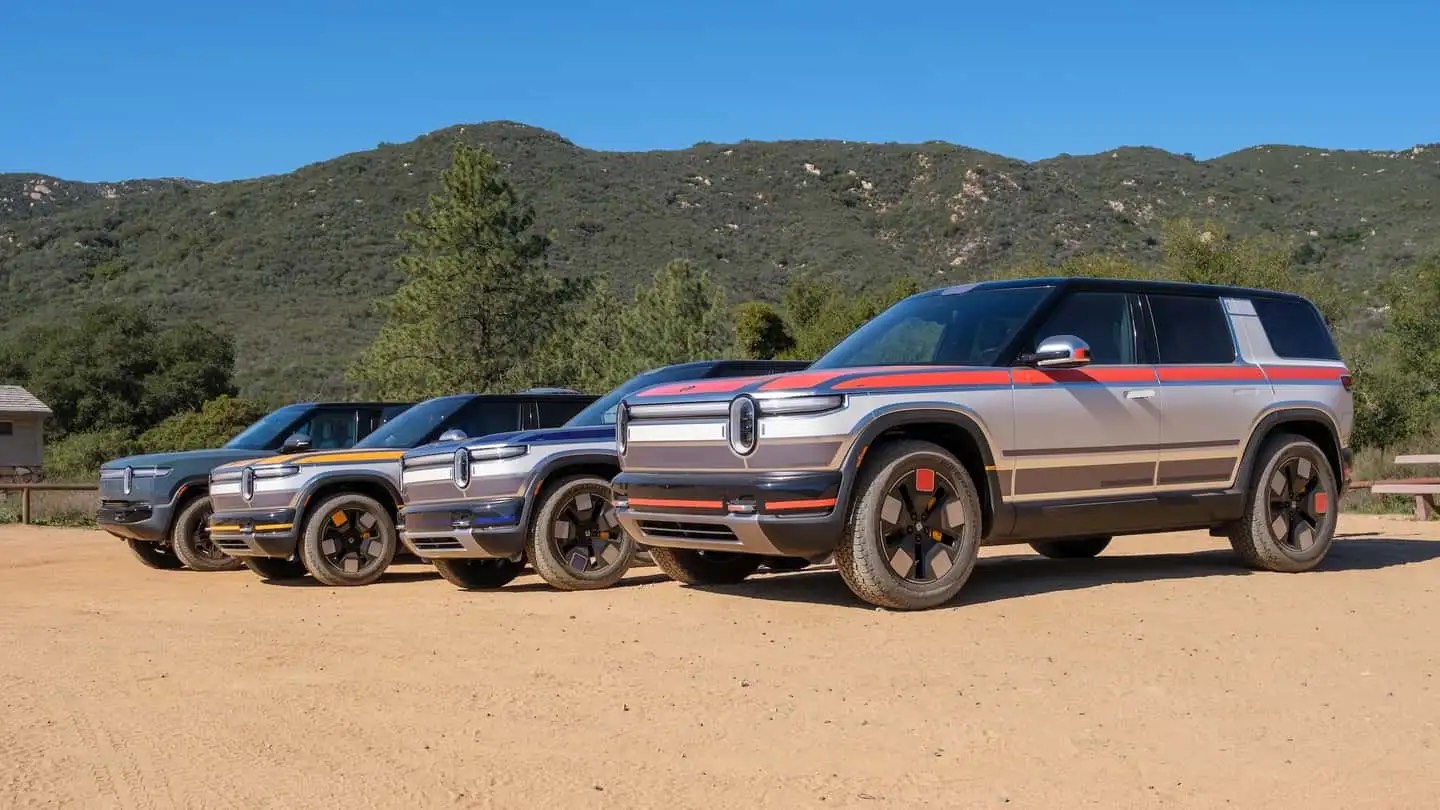
While Ford, GM, Ram, and Honda are busy taking billion-dollar writedowns and quietly walking their EV promises back to hybrid territory, Rivian just showed up at SXSW and unveiled an entire lineup of pure electric vehicles. No gas backup. No range extender. No hedging. Just EVs, all the way down.
Good. That’s exactly the right call.
I wrote about this recently, but the EV market right now is basically splitting into two groups: companies that actually believe in this technology, and companies that were always just along for the incentive money. Now that the $7,500 federal tax credit is gone and the political winds shifted, the second group is revealing itself. Ford killed the F-150 Lightning. Ram shelved its electric pickup before it ever hit production and slapped a plug-in hybrid badge on the replacement. Honda ate a $15 billion hit walking away from its 0 Series. These weren’t companies that ran out of runway. They were companies that were never really on the runway to begin with.
A hybrid isn’t a solution, it’s a stall tactic. You’re still carrying an engine, still changing oil, still tied to the gas supply chain, and still making design compromises because two powertrains are fighting for the same space. The battery ends up smaller than it could be and the engine ends up doing less than it would in a dedicated gas vehicle. Neither side of that equation wins.
Range extenders are marginally more honest about what they are, but there’s still a combustion engine in there, which means oil changes, fuel stops, and all the infrastructure dependency the whole exercise was supposed to leave behind. For someone who camps way off-grid, that backup might feel worth it. But it also just lets the real problem, the charging network gaps that actually cause range anxiety, stay someone else’s problem a little longer.
What Rivian has done differently is commit to solving those problems directly. Building the Adventure Network, engineering the R1 platform around one powertrain without having to accommodate anything else, and now doing it all over again from scratch with the R2 at a price point that actually reaches people. That’s not a small thing.
The U.S. slowdown is real but it’s mostly a policy story. The tax credit expired, tariffs made imported EVs nearly impossible to price right, and demand dipped. But global EV sales were still up 20% in 2025. The California and EU mandates haven’t budged. The destination hasn’t changed, just some of the companies making the trip have dropped out.
Which, honestly, might be fine. The ones leaving were never going to get there anyway.



I’m Day 1 R2 reservation holder who hopes to be able to purchase this Summer. I also put $100 reservation down on Apetera and hope they make it to production. Finally, I put $100 reservation on Scout. I like their design. However, I’m one of the 13% that reserved for an all electric version which doesn’t look like it is on VW’s radar anymore. I understand the attraction to range extended vehicles, but not for me even though I live in a rural area. Side note – Scout looks to be too big for me anyway. I am really impressed with the R2 packaging and think the launch edition is a great start.
I do hope Scout makes it to market, there is room for those type of vehicles in the market.
Rivian needs Scout to come to market. That VW money is part of their lifeline. If VW shuts Scout down on an impairment charge, that will impact Rivian upside on sharing the tech as well as any residual funding rounds still out there.
What about the Slate Truck?
Slate is fully electric, if it ever makes it to market it’ll be super awesome. I have a deposit on one!
Good article. I got rid of my used F250 Diesel and purchased my Rivian R1T in November 2023. So glad I made the switch to an EV from a dirty ICE vehicle. I have solar on my house and save $600 per month by not buying fuel.
I’ve owned 6 pickup trucks in my life and the Rivian is bar far the best I’ve ever owned. I use it for work as a carpenter everyday. I even built a custom Adventure/Work Truck Rack for it that can transport material up to 16′ long.
Make the switch to an EV, your wallet will thank you.
Same! I’ve owned many cars and trucks, Rivian is top of the list.
Bravo. Excellent closing. There are BEVs and then gas OEMs. Tesla, Rivian and Lucid can capitalize on that opportunity with volume and consistently improving. Meanwhile China can take over the rest of the automotive world.
I am not sure stall is the precise word for this situation.
I own 2 EV & 0 ICE. Anytime I speak with non-EV owners/drivers the unfounded concern around charging is real, and our current divisive politics don’t help. If we could get truly cheap EV (akin to BYD) I think the market would flip much more quickly. If charging took 5-10min for 80% which at scale is on the 5-10yr horizon people would be less apprehensive.
Instead of stall, I would say “delay”. Stall implies intentional, delay reflects waiting for market conditions to catch up to the future.
This is why I love writing stuff like this because it sparks conversation! My in-laws have an Avalon Hybrid and love it. They probably will never go full EV because they are super worried about charging even though I’ve expressed how it truly really isn’t a problem (especially for them who have a house). To your point though, you look at options like BYD and it really puts into perspective how behind the US is in EV tech.
Stall is the correct word. Most ICE vendors wish EVs would just go away. They would like to stall and hope EV demand magically just disappears. Delay suggests they are on board with EVs and waiting for….the second coming? Their EVs were not compelling, hence poor sales. Model 3 and Y were compelling and therefore sold well. The legacy companies risk becoming much smaller players in the worldwide electrified mobility movement. Ford, for example, may well become the next Kodak or Nokia.
Once again, legacy auto is playing short-term game and doing exactly what their investors want: short-term gain. And, again, these moves will hurt them in the long-run just like past decades (leading to yet another taxpayer funded bailout or some other form of rescue).
R2’s timing is perfect for Rivian.
Hybrids are the minidisc of cars.
Ten years ago plug in hybrids would have made sense for the US market. Next generations of the Volt, Prius Prime, Clarity, Pacifica, etc that could go 75-100 miles on a charge would have been fantastic (I would have bought one).
I agree with most on here, hybrid was never the answer. At best they are a stop gap measure to wean people off of petrol. I have two ev’s now and will add the R2S when lidar is included. I look forward to the day when gas is truly no longer a viable option.