
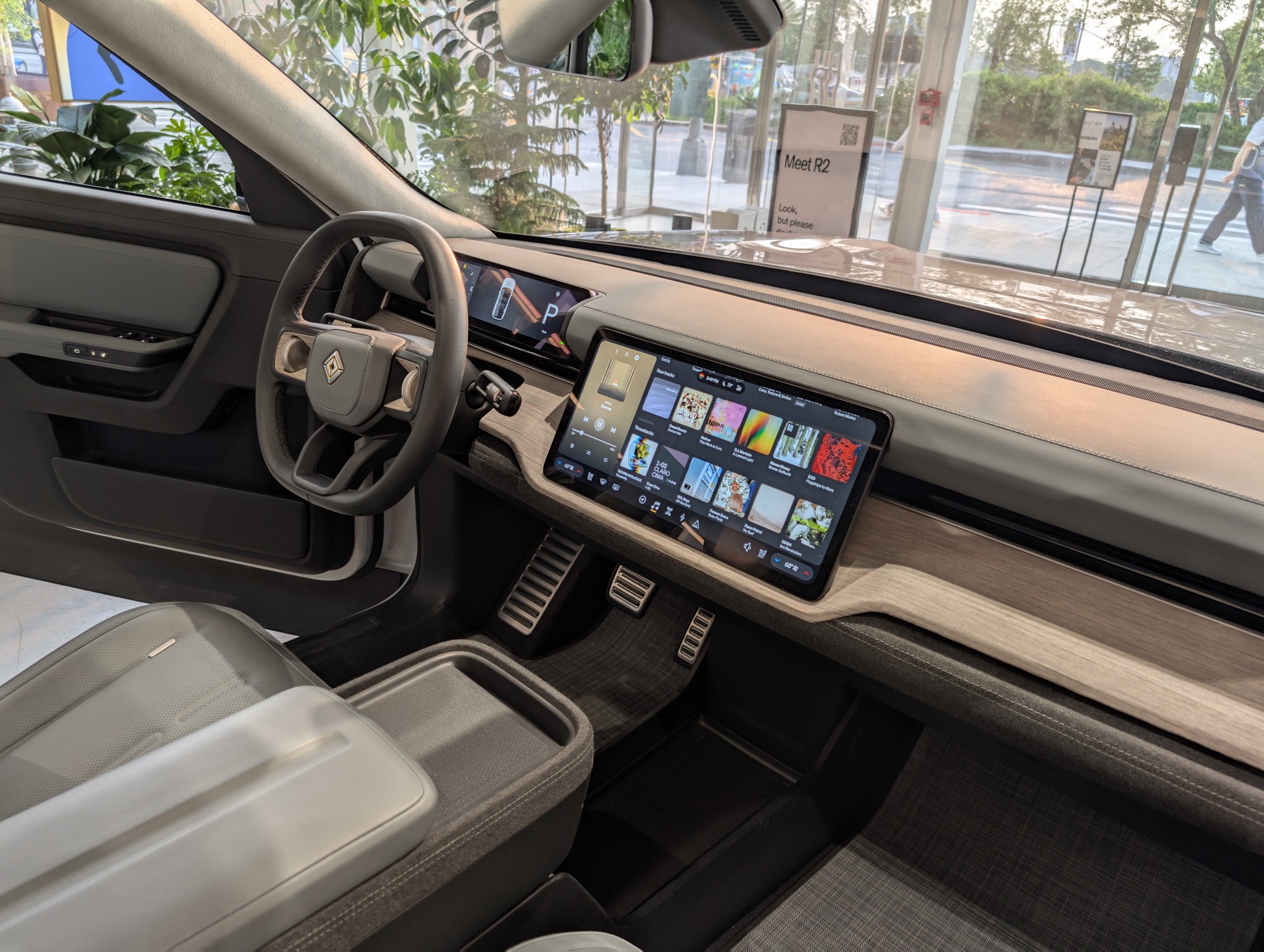
With R2 getting closer to launch, Rivian is about to face one of the hardest problems in modern vehicle development, software segmentation at scale. From the outside, it looks simple. One brand, one app, one Rivian experience. Under the hood, it is quickly becoming three very different hardware worlds that all need to move forward without dragging each other down.
We already saw the first cracks when Rivian introduced Gen 2 R1. On paper, Gen 1 and Gen 2 sounded like a clean split. In reality, it meant two different electrical and compute foundations running under what owners expect to be the same vehicle experience. Gen 2 was not just a refresh. Rivian rebuilt large parts of the vehicle architecture, consolidated modules, and pushed further toward a zonal style system that is far more software friendly long term. That is exactly the kind of change engineers want to make, but the transition exposed how painful it can be to support two generations at once.
Now Rivian is preparing to add R2, and this is where things get serious.
At that point, Rivian is no longer managing a simple Gen 1 versus Gen 2 split. They are supporting at least three distinct capability tiers. Gen 1 R1 vehicles sit on the oldest electrical and compute foundation. Gen 2 R1 vehicles represent Rivian’s current baseline for advanced driver assistance and future autonomy work. R2 is being positioned as the forward looking platform, with next generation autonomy hardware, in-house compute, and a sensor strategy that pushes beyond what today’s R1s can do.
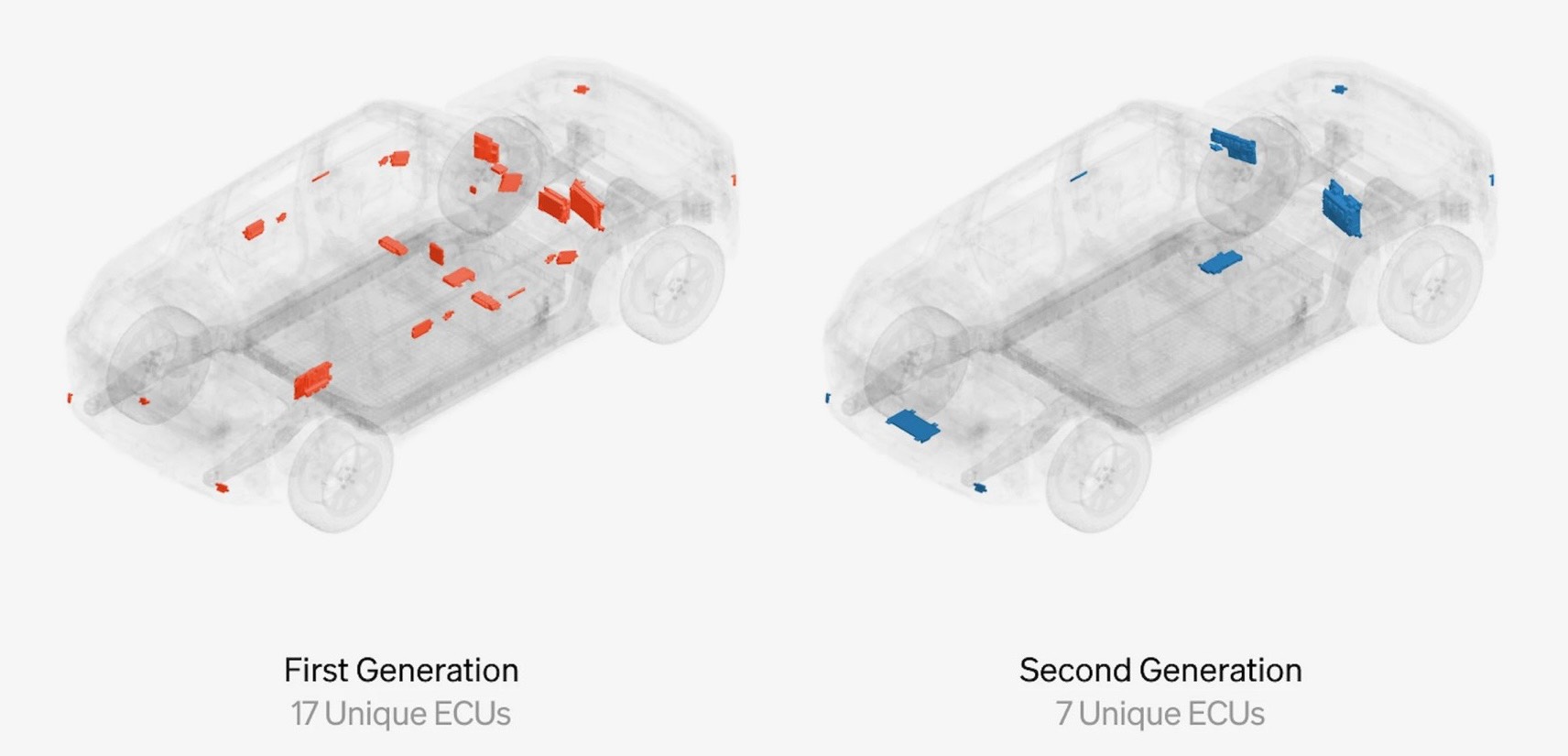
That creates a fundamental question. Does Rivian run three different software stacks, or do they find a way to unify everything without holding back the newest platform?
Running separate forks is the fastest way to lose control. Every fork multiplies testing, validation, and bug fixing. Features arrive at different times, regressions creep in unevenly, and owners start comparing notes on what feels arbitrary. It is expensive, slow, and scales poorly, especially once R2 volume ramps.
The only viable long term path is a single software trunk, with vehicles treated as capability sets rather than separate software versions.
That means one main release train, one core operating system, and a strong hardware abstraction layer underneath it. On top of that, features are gated by capability. Sensors, compute, and controllers determine what turns on, what stays hidden, and what runs in a reduced mode. The software is the same, the experience adapts.
We are already seeing the early shape of this. Driver assistance features are increasingly tied to Gen 2 hardware, and Rivian’s autonomy messaging is clearly oriented around newer platforms. From a software perspective, that is not segmentation, it is capability based delivery. The problem is that it often feels opaque to owners.
This is where Rivian needs to improve fast.
Owners can accept hardware limits. What frustrates people is not being told clearly where those limits are. When features quietly skip generations or arrive without context, it creates the sense that the rules are changing every update. Rivian needs to publish a living capability map that spells things out in plain language.
- This feature requires these sensors.
- This feature requires this compute tier.
- This feature is coming to these vehicles with these limits.
- This feature will not come to these vehicles, and here is why.
That single page would eliminate a huge amount of confusion, support load, and community speculation.
At the same time, Rivian needs to formalize a long term support mindset for Gen 1. That does not mean feature parity forever. It means security updates, critical bug fixes, reliability improvements, and quality of life updates continue, even as cutting edge autonomy and AI features focus on Gen 2 and R2 where the hardware margin exists.
Trying to keep Gen 1 fully in lockstep with future platforms would slow everything down to the pace of the oldest vehicle. That is how companies lose momentum. Rivian’s entire strategy around vertical integration, autonomy, and AI defined vehicles depends on moving forward without being anchored to past constraints.
R2 raises the stakes because it is the scale vehicle. When you ship at volume, fragmentation becomes brutally expensive. Small failure rates turn into large real world problems. That pressure naturally pushes software teams toward consolidation, discipline, and clarity.

In many ways, the Gen 2 growing pains were a lesson. Supporting two worlds is hard. Supporting three without a clear strategy would be worse.
The most likely outcome is that Rivian draws a line. Not a line that abandons Gen 1, but a line that clearly defines where future innovation lives. Next generation autonomy, deeper AI integration, and the long term vision will be built around newer platforms, with older vehicles supported in a stable, predictable way.
If Rivian makes three commitments before R2 launches, they can get ahead of this.
- One unified software release train.
- A published capability matrix that sets expectations clearly.
- Explicit long term support guarantees for Gen 1 focused on stability and security.
If they do that, software segmentation stops feeling like chaos and starts looking like a platform strategy.



Wonder if they’re even gonna release a software update this month?
Jose posted that there will be no January update. Probably prepping to roll out Rivian Assistant next month.
You mention three unique architectures, but Rivian has already shared it will be four when they quickly replace R2’s with their Gen3 Autonomy hardware and compute. Development and verification across two unique platforms, each of which has two distinct software compute architectures, sounds like a nightmare.
You’re right and I wouldn’t be surprised if the R1 gets an upgrade around the same time as R2 with LiDAR and the Rivian chip. That would create 3 R1 platforms and 2 R2 platforms by the end of 2026. It might actually be easier to support going forward if the 2027 R1 and R2 have basically the same sensor and compute platforms.
Thanks for writing this, Jose. We need more articles that explain the complexity of maintaining software over time and variations in hardware stacks. If nothing else, we can point to these when people rant about not getting the latest new feature in their existing vehicle.
I own a Gen 2 R1T and I’ve really been excited by the recent interviews that Rivian staff have done outlining the future path for autonomy. BUT I realize that if I want many of the Gen 3 capabilities I will need a hardware platform (ie. truck) capable of supporting them.
Backward compatibility can be an anchor that drags down future development.
This is a pretty good summary for non-dev types. Nicely done.
There’s a human factor here, too: keeping a unified codebase and release train requires a values alignment from top to bottom between anyone who influences development. From interns to C-staff, dev to product, quality to regulatory compliance. Every single person needs to understand why unity is so important, and the true costs and impacts of falling out of step.
Whether it’s a Product Manager who doesn’t put serious thought into backwards or forward compatibility because they just want to get their feature in, or a junior dev who doesn’t understand why all those boilerplate-looking feature flags are important, or the executive who grumbles that maintaining R1G1 is dragging down velocity and inflating the budget. It only takes one person going rogue, one fork which should have been a patch, to splinter the effort into sharp fragments which quickly become all but impossible to put back together.
I’ve been in the biz for 30 years, with the past 10 doing cloud software platforms and architecture for physical medical devices. The industries are effectively the same: consumer products focused on safety, with heavy regulation, but driven by market forces to constantly move forward.
It is really, really hard to get a room full of smart, passionate people to agree to put their egos aside and focus on unity. It takes a strength of character you don’t see as often as you’d like. And, as you said, clearly-communicated vision with specific details and not hand-wavy empty promises. But it can’t come from one person – it has to be an organizational culture, or it doesn’t work.
I want to hope that Rivian’s engagements with VW and Amazon have given them enough outside perspective, enough distant targets, to entrench that need for unity.
But … TBH, that’s not what I’ve seen come out of that team so far. You don’t get misses like the Google Maps nonsense from a team which is focused on configuration-driven feature management.
We shall see, though. They’re barely a 1.0 product. There’s still time.
Things will get even more complicated, now that VW wants to personalise the software stack for Audi, Porsche, and probably they want individual models personalisation as well.
No concerned in the slightest. Rivian has proven its software chops time and again. There will always be some that scrutinize everything to death, especially if the vehicle is an EV. There will be many generations and many new models. Rivian has The Right Stuff to handle it. Legacy companies trying to make EVs? Not so much.
My concern is that software defined vehicles become obsolete much faster than traditional vehicles. I have kept my vehicles for an average of over 10 years with our family currently using 2009, 2010 and 2022 vehicles (all in excellent condition).
Vehicles are too expensive to become obsolete in less than 10 years but it appears that may be the case if the cost to update the complex software is too great to justify long term support.
Not sure what you mean here…
If Rivian decides to stop updating software on a Gen1 R1 vehicle, it’s not like the current software will stop working and all the sudden become less reliable. At that point the vehicle operates the same as your previous “traditional” vehicles.
Agreed, Andrew.
@Chris – I’m assuming your 2009 and 2010 vehicles (and possibly even your 2022 depending on the vehicle) have never had a software update – or haven’t in years. And they still operate the same. Don’t get me wrong, I think Gen1 would still get support and updates within the capabilities of the hardware platform. However, if it were feature-frozen, it would still work as it does now for years to come.
This raises a critical point about scalability and user trust in vehicle software. A unified software trunk with capability-based feature gating makes sense long term, but Rivian clearly needs better transparency. How can they communicate these hardware-driven limitations without alienating early adopters?
Valid concern unless you know their chief software guy – Wassym/B. I am certain he has this figured out and will handle accordingly.
Could Rivian not offer a hardware upgrade to change/upgrade the cameras and the computer system. Gen 1 vs Gen 2 footprint are generally the same layout, are they not? With the exception of some cables and harnesses? I know if would be costly, but maybe not as costly as upgrading to an entirely new Rivian vehicle? This way they can streamline the software process, ans it would give owners at least a choice to keep their vehicles and upgrade if they want?
Gen1 and gen2 are fundamentally different. You cannot simply plug in a new computer and cameras. It would require entirely new hardware and software to accomplish such an upgrade. It’s more likely that gen2 hardware could be upgradable in the future.
The impact of supporting the Volkswagen group companies will be the biggest factor, I feel. Very different architectures (electric BEV, REV, Hybrid and Gas) and the need to customize for each vehicle (Scout, Audi, Porsche, etc). So this topic gets even more relevant and complex than just R2. RJ isn’t having emergency meetings about R2 support in the software – it’s about delayed Audi launch dates because of the software.
On another note – I am hoping we get a 2026 release soon (on 2025.46.30 at this moment) that switches us to Gemini based intelligence/assistant. Coming from Tesla, I really think that’s a potentially huge unlock for the system – being able to integrate maps, vision/sensor, location, calendar, messaging, and internet information will be a big deal and will help devs in many many ways.