
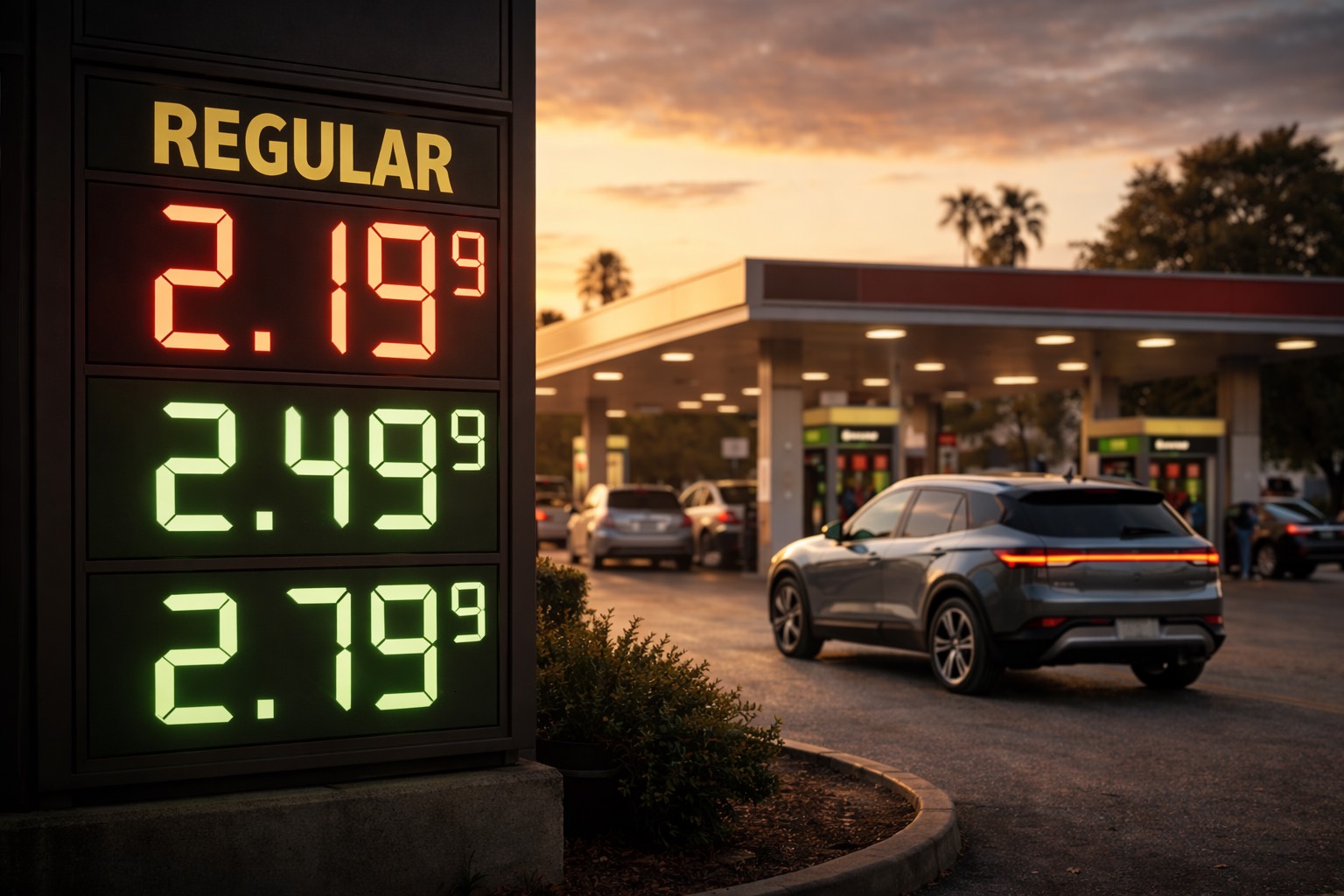
Gas prices are coming down across the US, and whether EV fans like it or not, that matters.
Right now, average gas prices are noticeably lower than they were a year or two ago, and in some parts of the country they are flirting with levels that feel, for lack of a better word, normal again. For the average driver, that changes the emotional math almost overnight. When filling up costs under $3 per gallon, the pain fades fast, and with it, the urgency that pushed a lot of buyers to seriously consider going electric in the first place.
This is where the EV conversation gets uncomfortable, because people do not buy vehicles based on long-term spreadsheets. They buy based on what they feel every week. High gas prices are a constant reminder that something is broken. Low gas prices feel like a problem that quietly solved itself. Even if that feeling is temporary, it has real consequences in the showroom.
tl;dr
- Gas prices are falling across the US
- Cheaper gas reduces urgency to go electric
- Many buyers stop doing the EV math when gas is cheap
- EV sales are more sensitive to incentives than fuel prices
- Lower gas prices push some shoppers to hybrids or ICE
- EVs now have to win on experience, not fear
- Cheap gas slows momentum, but does not stop EV adoption
There is solid research backing this up. Multiple studies have shown that gas prices are one of the strongest short-term drivers of EV interest. When prices spike, EV shopping surges. When prices fall, that momentum slows. Not because EVs suddenly stop making sense, but because the most obvious financial advantage becomes less visible. If you are not staring at a painful receipt at the pump every seven days, it is easier to justify sticking with what you already know.
But here is the important part, and this is where the headline “cheap gas kills EVs” starts to fall apart.
The recent ups and downs in EV sales have had far more to do with incentives and pricing than gas prices alone. When the federal tax credit was about to expire in late 2025, EV sales spiked hard. When it disappeared, sales dropped just as quickly. That was not because gas got cheaper overnight. It was because the deal changed. At the same time, affordable EV options are still limited compared to gas vehicles, especially under $40,000, and that reality matters way more to mainstream buyers than a twenty or thirty cent swing at the pump.
Lower gas prices absolutely act as a headwind, especially for first-time EV buyers who are already on the fence. It makes the payback story harder to tell. It pushes some shoppers toward hybrids instead of full EVs. It slows down the “I’m done with gas forever” mindset. All of that is real.
What it does not do is reverse the long-term shift.
For brands like Rivian, this moment is actually a stress test, and maybe a healthy one. When gas is cheap, EVs have to stand on their own. They have to win on daily experience, not fear of fuel prices. Quiet drives. Smooth power delivery. Charging at home that fits your routine. Software that genuinely improves the vehicle over time. Lower maintenance that shows up months later, not just on day one. Those benefits do not disappear just because gas dips for a while.
If anything, cheaper gas exposes which EVs are compelling products and which ones were leaning too hard on incentives.
The reality is that gas prices are cyclical. They always have been. Building an EV strategy around permanently expensive gas is a mistake. Building EVs that people want regardless of what the sign at the gas station says is the only long-term play.
So yes, lower gas prices will likely cool EV sales growth in the short term. That is unavoidable. But if EV adoption stalls because gas dropped for a season, then the market was not as strong as it needed to be in the first place.
The next phase of EV growth is not about escaping expensive gas. It is about offering a better ownership experience. The companies that understand that will keep moving forward, even when filling up feels cheap again.



It costs me more to drive my Gen2 R1T on road trips then it would a gasoline truck the equivalent weight with the insane prices they’re charging at Level 3 chargers. In Seattle it costs over $0.58/kWh to fast charge. The only benefit for EV’s is when you’re traveling less than 100 miles one way right now.
That’s not really true, is it? I drove a 3000 mile trip in my R1T and the”fuel” cost was roughly equivalent to an ICE, but I didn’t need an oil change after the trip swell as other ICE-only mnt. That alone was cost effective.
I did all the calculations with the efficiency, and electric cost and I’m getting here in 40F to 50F real world conditions and my truck efficiency was equivalent to driving a 14/mpg vehicle at current gasoline prices.
It definitely depends on the location as here in Florida, it is super cheap to charge with electricity so it is cheaper than gas!
My household needs (not wants) another vehicle in 2026 and R2 is the perfect solution in terms of size, features, cost to charge at home, and everything with the bi-directional house backup being a HUGE selling point because our house experiences frequent, but short outages (less than 24 hours usually). R2 is really a fantastic option for us, but also sales price plays a role.. so my hope is the launch R2 and what follows this year will be competitive in pricing because I don’t want to buy an ICE or Hybrid, but I also can’t go broke on a high car payment.
Agree that lower gas prices offset the sometimes crazy high charging rates on the road. I have a 25 R1s max and we can comfortably drive within 350 miles (give or take with extreme weather) to a destination and charge for free and return home. When we lived in san diego, that meant driving to Palm Springs, Santa Barbara or any place within a few hours and charging for free at a hotel or Airbnb.
I just bought a used model 3 and shipped it to my daughter at college because she can charge for free on campus, use it to drive to visit her friends at schools within 3 hours around her and drive to work with minimal to no maintenance costs.
I live in Northern California. A Tesla charger is .62, that is crazy. I bought my first ev in 2021 and it was .42 at the same charger. That is the thing that surprised me.
Electricity costs really are a concern. My take is it’s greed. No reason RAN needs to cost $0.60+, if anything it should be cost of kw+ 10% which in many commercial contacts in California can be 20-40 cents.
If Level-3 charging is priced based on competitive rates and demand, then maybe we will finally see these $0.65/kW station charges drop. Living in California and using any of the providers along the main highways is currently at least a $35 hit for me to go from 30% to 80% SOC. The only good news is that the number of locations has significantly increased in the past two years.
Low gas prices for this long have been a surprise to me as well. If only EV’s could get some love for helping keep global demand low and prices under $3 gallon.